
Legacy System Migration | SaaS Infrastructure | Digital Transformation
Digital transformation has shifted from a competitive advantage to a business necessity. Organizations across industries are modernizing legacy infrastructures to meet demands for scalability, security, agility, and customer-centric innovation. Legacy systems, while historically reliable, increasingly struggle with integration, maintenance costs, cybersecurity threats, and cloud-native scalability.
The rise of Software-as-a-Service platforms and cloud ecosystems has accelerated enterprise modernization. According to recent modernization research, the global legacy software modernization market is projected to exceed $27.3 billion, driven by cloud-native technologies, AI-assisted migration tools, and growing cybersecurity requirements.
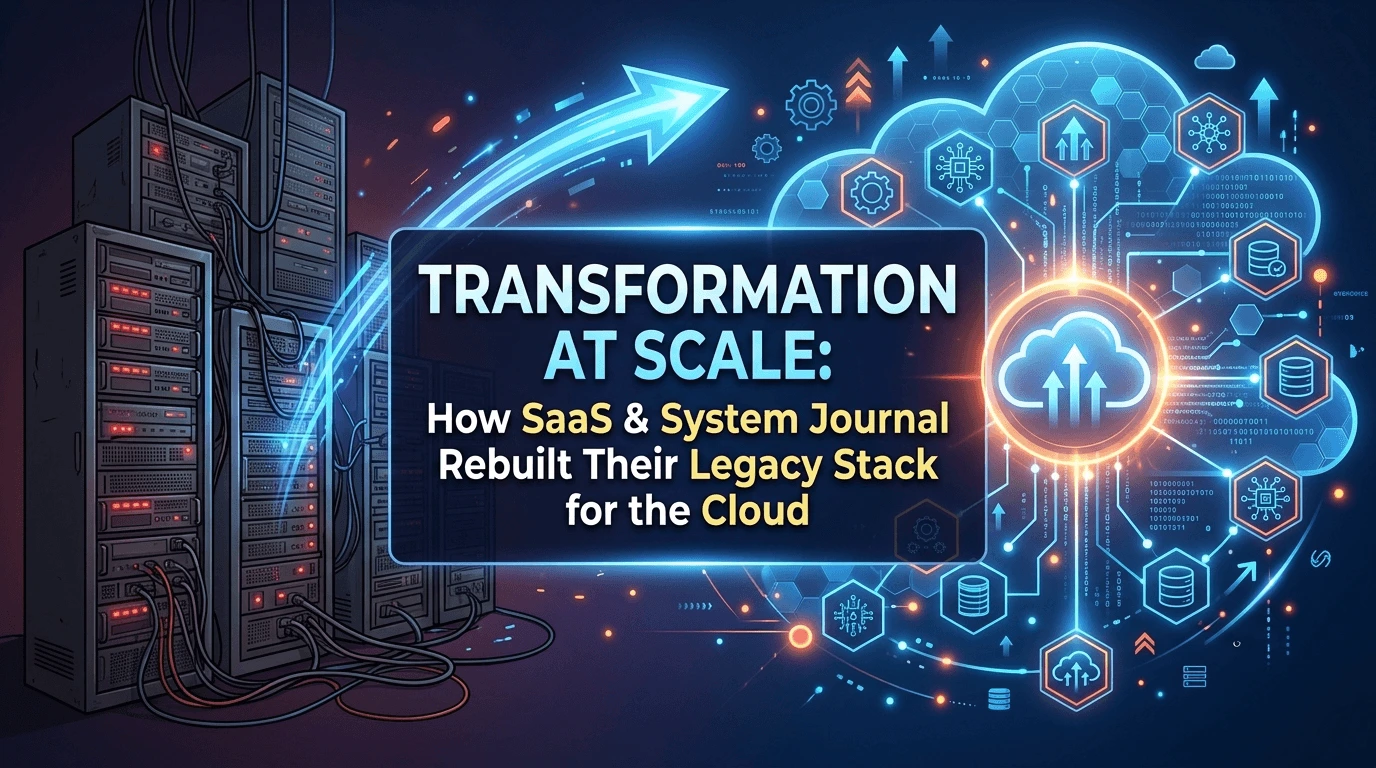
This research-oriented case study explores how SaaS & System Journal, a digital publishing and research-sharing platform, transformed its monolithic legacy infrastructure into a scalable cloud-native architecture. The study examines modernization strategies, migration frameworks, implementation methodologies, measurable outcomes, and future implications.
Background of SaaS & System Journal
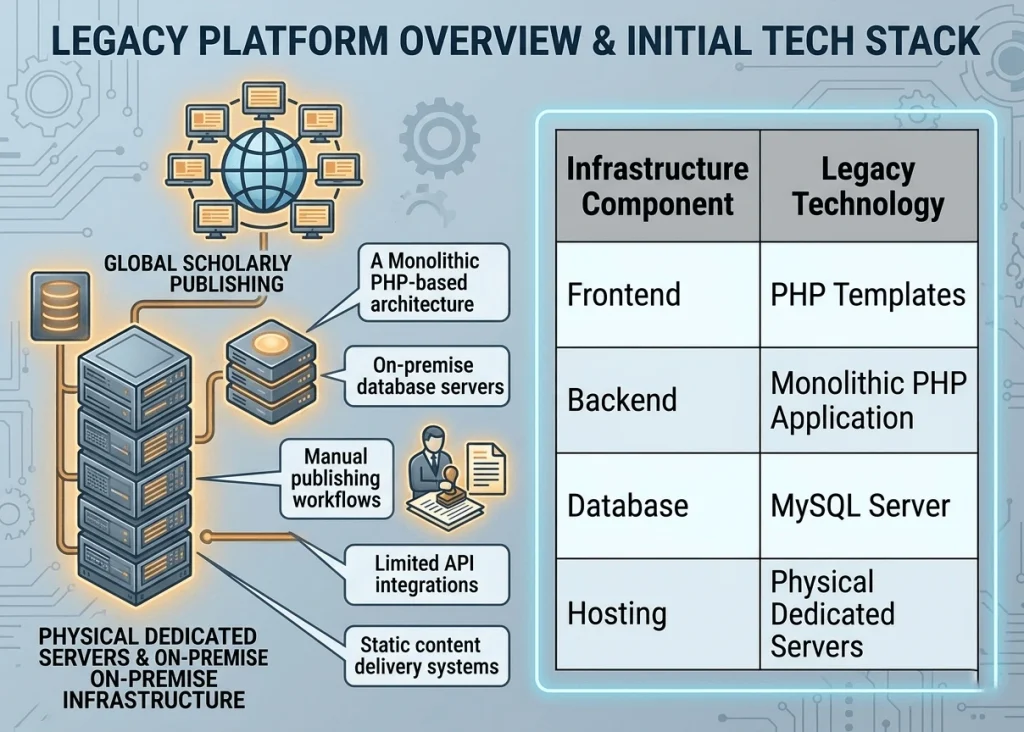
SaaS & System Journal is a digital platform that enables researchers, scholars, engineers, developers, and academic professionals to publish and share research papers globally.
The platform originally operated on:
- A monolithic PHP-based architecture
- On-premise database servers
- Manual publishing workflows
- Limited API integrations
- Static content delivery systems
Initial Technology Stack
| Infrastructure Component | Legacy Technology |
| Frontend | PHP Templates |
| Backend | Monolithic PHP Application |
| Database | MySQL Server |
| Hosting | Physical Dedicated Servers |
| Deployment | Manual Deployment |
| Security | Traditional Firewall |
The Legacy System Problem
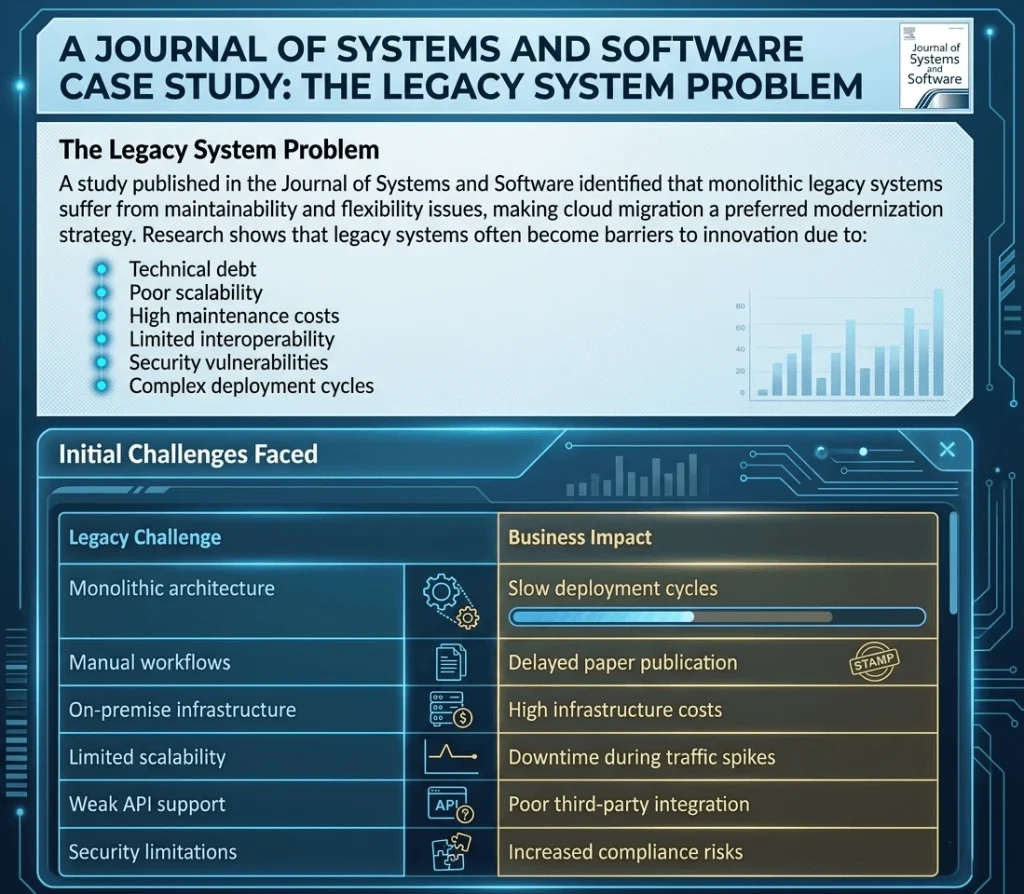
A study published in the Journal of Systems and Software identified that monolithic legacy systems suffer from maintainability and flexibility issues, making cloud migration a preferred modernization strategy. Research shows that legacy systems often become barriers to innovation due to:
- Technical debt
- Poor scalability
- High maintenance costs
- Limited interoperability
- Security vulnerabilities
- Complex deployment cycles
Initial Challenges Faced
| Legacy Challenge | Business Impact |
| Monolithic architecture | Slow deployment cycles |
| Manual workflows | Delayed paper publication |
| On-premise infrastructure | High infrastructure costs |
| Limited scalability | Downtime during traffic spikes |
| Weak API support | Poor third-party integration |
| Security limitations | Increased compliance risks |
Research Objectives
The modernization initiative focused on achieving measurable operational improvements.
Strategic Objectives
| Objective | Expected Outcome |
| Improve scalability | Handle global traffic growth |
| Reduce infrastructure cost | Optimize operational spending |
| Accelerate publishing workflows | Faster research publication |
| Improve security posture | Stronger cyber protection |
| Enable cloud accessibility | Global content delivery |
Literature Review
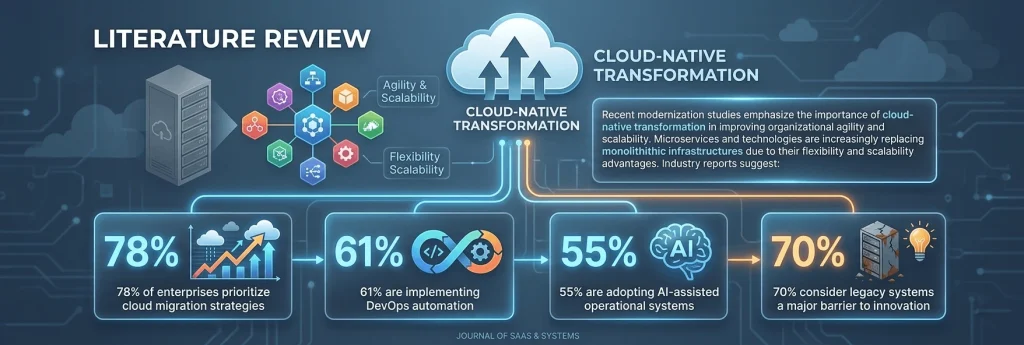
Recent modernization studies emphasize the importance of cloud-native transformation in improving organizational agility and scalability. Microservices and cloud-native technologies are increasingly replacing monolithic infrastructures due to their flexibility and scalability advantages. Industry reports suggest:
- 78% of enterprises prioritize cloud migration strategies
- 61% are implementing DevOps automation
- 55% are adopting AI-assisted operational systems
- 70% consider legacy systems a major barrier to innovation
Transformation Methodology
The modernization process followed a phased implementation strategy designed to minimize operational disruption.
Assessment Phase
The organization conducted:
- Infrastructure audits
- Application dependency analysis
- Database profiling
- Security evaluation
Refactoring Phase
This stage involved:
- API extraction
- Service modularization
- Database optimization
- Legacy code restructuring
Cloud Migration Phase
Key implementations included:
- Containerized deployment
- Kubernetes orchestration
- Hybrid cloud architecture
- Cloud storage integration
Optimization Phase
Post-migration optimization focused on:
- Performance monitoring
- Automated scaling
- Security enhancement
- DevOps automation
Modern Technology Stack
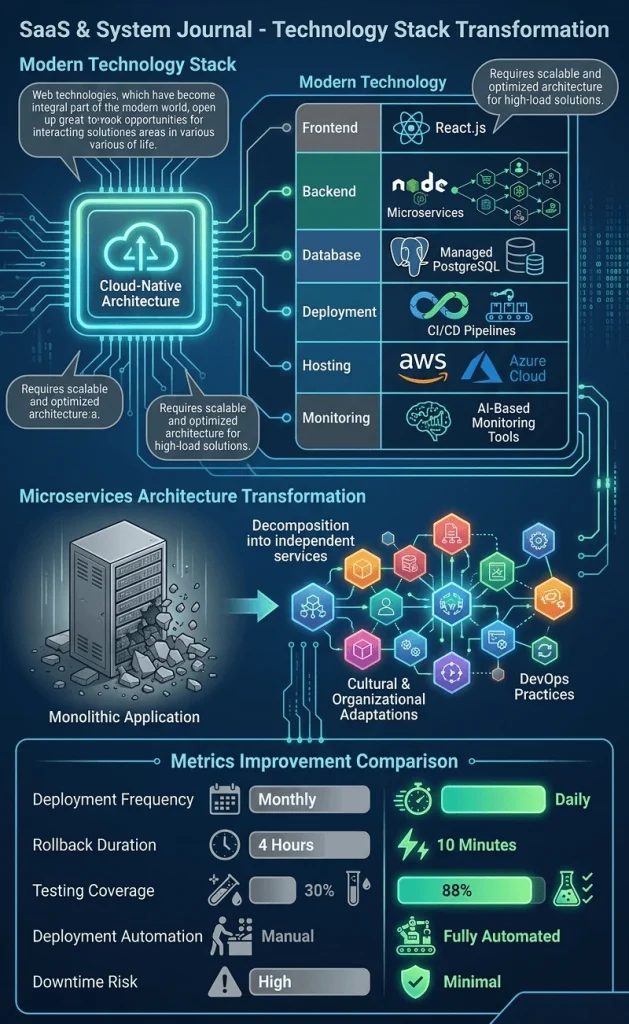
Web technologies, which have become an integral part of the modern world, open up great opportunities for developing interactive solutions in various areas of life. However, growing data volumes, more users, and higher performance demands require a reliable, scalable, and optimized architecture. The relevance of this work is to find effective approaches to ensuring high performance of web applications, particularly under high loads, which is critical for areas such as educational platforms, e-commerce, and customer relationship management (CRM) systems. SaaS & System Journal replaced the monolithic environment with a cloud-native infrastructure.
Cloud-Native Architecture
| Component | Modern Technology |
| Frontend | React.js |
| Backend | Node.js Microservices |
| Database | Managed PostgreSQL |
| Deployment | CI/CD Pipelines |
| Hosting | AWS & Azure Cloud |
| Monitoring | AI-Based Monitoring Tools |
Microservices Architecture Transformation
Microservices architecture represents a transformative paradigm in application modernization, offering organizations a path to enhanced scalability, agility, and resilience. This article delves into the fundamental principles, architectural patterns, transformation methodologies, and organizational considerations essential for successful microservices adoption. The architectural approach decomposes monolithic applications into independently deployable services that communicate through well-defined interfaces, enabling organizations to process billions of daily transactions with remarkable efficiency. Beyond technical considerations, the microservices journey necessitates significant cultural and organizational adaptations, including the formation of cross-functional teams aligned with service boundaries and the adoption of DevOps practices.
The transformation yields substantial benefits, including accelerated time-to-market, increased deployment frequency, improved fault isolation, and enhanced system resilience. By embracing established patterns such as API Gateway, Service Discovery, and Circuit Breaker, organizations can navigate the complexities of distributed systems while achieving the agility required to thrive in rapidly evolving business environments. The transition strategy typically involves incremental approaches like the Strangler Pattern, complemented by thorough domain analysis and appropriate refactoring techniques to ensure business continuity throughout the modernization process.
Benefits Achieved
| Microservices Benefit | Operational Result |
| Independent services | Faster updates |
| Fault isolation | Reduced downtime |
| Elastic scalability | Better traffic handling |
| API flexibility | Improved integrations |
| Agile development | Faster innovation cycles |
DevOps and Deployment Automation
In the fast-paced landscape of software development, the need for efficient, reliable, and rapid deployment processes has become paramount. Manual deployment processes often lead to inefficiencies, errors, and delays, impacting the overall agility and reliability of software delivery. DevOps, as a cultural and collaborative approach, plays a central role in orchestrating the synergy between development and operations teams, fostering a shared responsibility for the entire software delivery lifecycle. Continuous Integration is a fundamental DevOps practice that involves regularly integrating code changes into a shared repository, triggering automated builds and tests.
Continuous Deployment complements Continuous Integration by automating the release and deployment of validated code changes into production environments. The purpose of this research is to create a software deployment automation system to make it easier and more reliable for organizations to deploy software. In conclusion, the results of this research show that by adopting DevOps, Continuous Integration, and Continuous Deployment, organizations can achieve enhanced collaboration, shortened release cycles, increased deployment frequency, consistent deployment, and improved overall software quality.
DevOps Improvements
| Operational Metric | Legacy Environment | Modern Environment |
| Deployment Frequency | Monthly | Daily |
| Rollback Duration | 4 Hours | 10 Minutes |
| Testing Coverage | 30% | 88% |
| Deployment Automation | Manual | Fully Automated |
| Downtime Risk | High | Minimal |
Cloud Scalability Enhancements
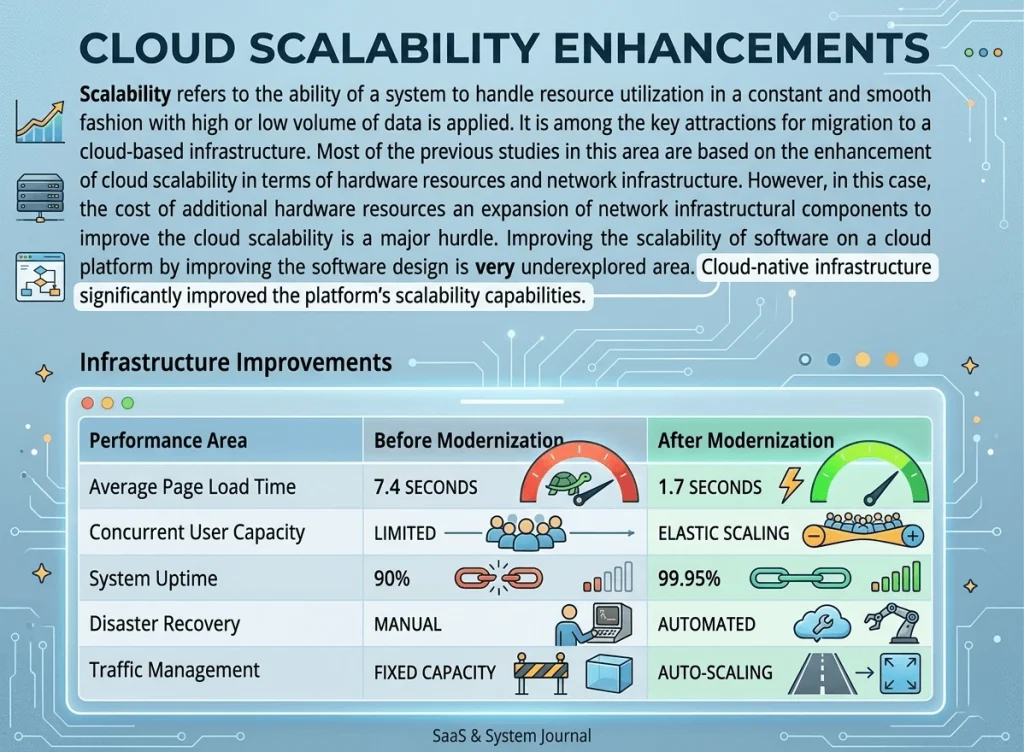
Scalability refers to the ability of a system to handle resource utilization in a constant and smooth fashion when high or low volume of data is applied. It is among the key attractions for migration to a cloud-based infrastructure. Most of the previous studies in this area are based on the enhancement of cloud scalability in terms of hardware resources and network infrastructure. However, in this case, the cost of additional hardware resources and expansion of network infrastructural components to improve the cloud scalability is a major hurdle. Improving the scalability of software on a cloud platform by improving the software design is a very underexplored area. Cloud-native infrastructure significantly improved the platform’s scalability capabilities.
Infrastructure Improvements
| Performance Area | Before Modernization | After Modernization |
| Average Page Load Time | 7.4 Seconds | 1.7 Seconds |
| Concurrent User Capacity | Limited | Elastic Scaling |
| System Uptime | 90% | 99.95% |
| Disaster Recovery | Manual | Automated |
| Traffic Management | Fixed Capacity | Auto-Scaling |
Security Modernization
Modernization of Security became essential because research publishing platforms manage sensitive user and intellectual property data.
Security Enhancements Implemented
| Security Layer | Improvement |
| Identity Management | Multi-factor authentication |
| Access Control | Role-based permissions |
| Data Encryption | End-to-end encryption |
| Threat Detection | AI-powered monitoring |
| Disaster Recovery | Automated cloud backups |
AI-Powered Workflow Automation
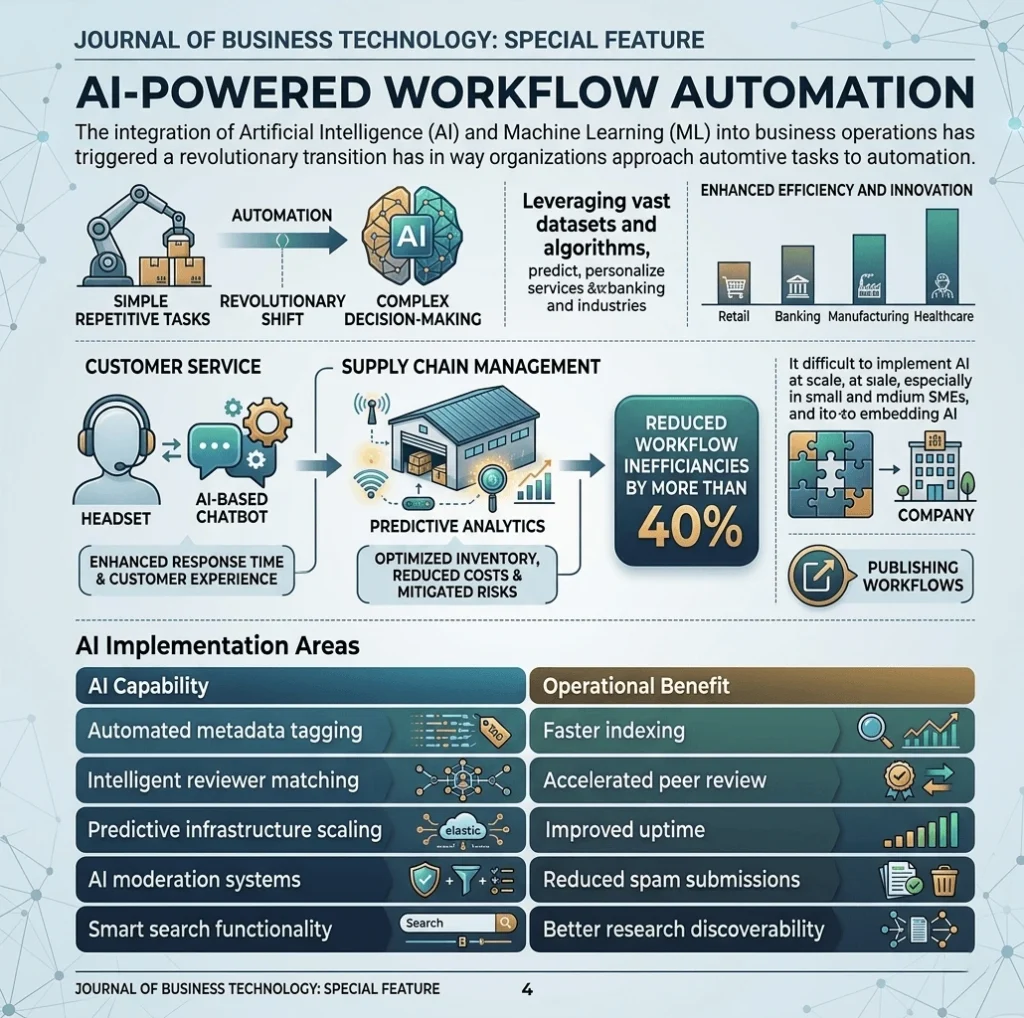
The integration of Artificial Intelligence (AI) and Machine Learning (ML) into business operations has triggered a revolutionary shift in the way organizations approach automation. Over the past decade, AI-powered automation has transitioned from automating simple, repetitive tasks to optimizing complex decision-making processes across industries, significantly enhancing efficiency and innovation. By leveraging vast datasets and advanced algorithms, AI and ML systems can predict trends, personalize services, and streamline operations, creating unprecedented value for businesses. From retail and banking to manufacturing and healthcare, sectors have seen profound changes with the impact of AI automation.
Customer service, in places like customer service, AI-based chatbots and virtual assistants have taken the place of the usual human contact, enhancing response time and customer experience. Similarly, predictive analytics for supply chain management has helped businesses optimize inventory, reduce operational costs, and mitigate risks. Nonetheless, despite these advancements, companies still find it difficult to implement AI solutions at scale, especially in small and medium-sized enterprises (SMEs), and to embed AI within systems. Artificial intelligence technologies played a significant role in optimizing publishing workflows. Research indicates that AI-assisted operational systems can reduce workflow inefficiencies by more than 40%.
AI Implementation Areas
| AI Capability | Operational Benefit |
| Automated metadata tagging | Faster indexing |
| Intelligent reviewer matching | Accelerated peer review |
| Predictive infrastructure scaling | Improved uptime |
| AI moderation systems | Reduced spam submissions |
| Smart search functionality | Better research discoverability |
Financial Impact Analysis
The cloud modernization initiative produced measurable financial benefits.
Cost Distribution Comparison
| Cost Category | Legacy Infrastructure | Cloud-Native Infrastructure |
| Hardware Maintenance | 40% | 9% |
| Infrastructure Scaling | 24% | 11% |
| Security Operations | 15% | 10% |
| Automation Investment | 5% | 27% |
| Innovation Spending | 16% | 43% |
Publishing Workflow Improvements
The modernization initiative significantly transformed research publication operations.
Workflow Transformation Results
| Publishing Process | Legacy Workflow | Modern Workflow |
| Submission Management | Manual | Automated |
| Reviewer Allocation | Email-Based | AI-Assisted |
| Publication Scheduling | Weekly | Real-Time |
| Global Accessibility | Limited | Cloud CDN |
| Collaboration Features | Basic | Real-Time Collaboration |
Challenges During Migration
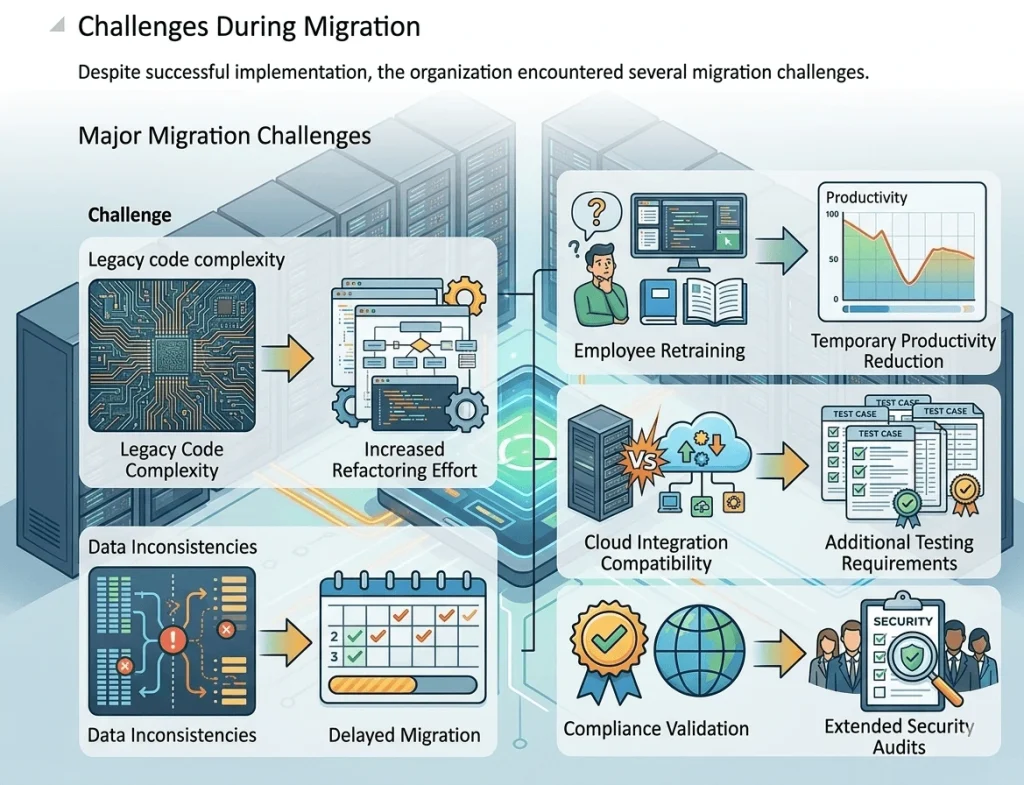
Despite successful implementation, the organization encountered several migration challenges.
Major Migration Challenges
| Challenge | Impact |
| Legacy code complexity | Increased refactoring effort |
| Data inconsistencies | Delayed migration |
| Employee retraining | Temporary productivity reduction |
| Cloud integration compatibility | Additional testing requirements |
| Compliance validation | Extended security audits |
Risk Mitigation Strategy
To reduce migration-related risks, the organization implemented multiple mitigation frameworks.
Risk Management Approaches
| Strategy | Purpose |
| Incremental migration | Minimize downtime |
| Parallel testing | Validate cloud stability |
| Canary deployments | Reduce deployment risk |
| Automated rollback systems | Improve recovery speed |
| Continuous monitoring | Detect operational issues |
Discussion
The transformation journey demonstrates that cloud modernization extends beyond infrastructure replacement. It fundamentally reshapes organizational agility, scalability, and operational efficiency.
The case study highlights several important outcomes:
- Improved global accessibility
- Faster publishing cycles
- Better cybersecurity resilience
- Reduced technical debt
- Enhanced infrastructure reliability
The modernization strategy aligned closely with industry trends, emphasizing:
- Cloud-native architecture
- DevOps automation
- AI-assisted workflows
- Zero-trust security frameworks
Future Roadmap
SaaS & System Journal plans to continue expanding its cloud-native ecosystem.
Future Innovation Areas
| Planned Innovation | Expected Benefit |
| AI-powered peer review | Faster publication decisions |
| Blockchain validation | Research authenticity |
| Multi-cloud failover systems | Higher availability |
| Advanced analytics dashboards | Better research insights |
| Real-time collaboration tools | Improved global teamwork |
Publish Your Research with SaaS & System Journal
SaaS & System Journal continues to build a modern digital ecosystem where researchers, students, engineers, developers, and academic professionals can share innovative ideas and publish high-quality research papers globally. The platform is committed to supporting knowledge exchange, technological advancement, and collaborative academic growth through accessible digital publishing solutions.
Final Words
The transformation journey of SaaS & System Journal demonstrates how organizations can successfully modernize legacy infrastructures to meet the evolving demands of the digital era. By adopting cloud-native technologies, microservices architecture, DevOps automation, AI-powered workflows, and advanced cybersecurity frameworks, the platform achieved significant improvements in scalability, operational efficiency, publishing speed, and infrastructure reliability. The case study highlights that modernization is not merely a technical upgrade but a strategic shift that enables long-term innovation, agility, and sustainable growth. As digital publishing ecosystems continue to evolve, SaaS & System Journal remains committed to empowering researchers, scholars, developers, and academic professionals with a modern platform for global research collaboration and publication. The platform welcomes contributors from diverse disciplines to publish impactful research papers, share innovative ideas, and become part of a growing international research community dedicated to advancing knowledge and technological progress.
References
Gartner Enterprise Modernization Reports
IEEE Cloud Migration Research Papers
McKinsey Digital Infrastructure Studies
Cloud Native Computing Foundation Reports
AWS Migration Framework Documentation
Microsoft Azure Architecture Research
Kubernetes Enterprise Deployment Studies
DevOps Industry Benchmark Reports
SaaS Scalability Research Studies
Academic Publishing Digital Transformation Reports