Predictive AI for Customer Churn | Behavioural Anomaly Detection | Customer Retention Optimization
In today’s digital landscape, businesses face a significant challenge: delivering personalised customer experiences while navigating an increasingly complex privacy regulatory environment. Customer Data Platforms (CDPs) have emerged as critical infrastructure for modern enterprises, promising to create a unified 360-degree view of each customer. According to Allied Market Research’s comprehensive analysis, the global CDP market was valued at $1.5 billion in 2023 and is projected to reach $6.9 billion by 2033, growing at a remarkable 16.3% CAGR from 2024 to 2033, underscoring the increasing recognition of CDPs as essential business technology. However, traditional CDPs often struggle with real-time data processing, identity resolution, and privacy compliance, with organisations reporting significant challenges in realising the full potential of their customer data investments.
The integration of artificial intelligence into these platforms represents a transformative approach that addresses these limitations while unlocking new capabilities for personalisation, compliance, and customer engagement. As highlighted in Forrester’s 2024 Customer Data Platform Wave report, AI-augmented CDPs are revolutionising the way organisations leverage customer data, with leading platforms now processing over 8.5 billion customer interactions daily and achieving identity resolution rates exceeding 92% across channels. This performance improvement translates directly to business outcomes, with Forrester’s analysis revealing that organisations implementing AI-enhanced CDPs report an average 23% increase in marketing ROI and 19% improvement in customer retention metrics compared to those using conventional data management approaches. Companies use machine learning churn prevention to improve customer retention and reduce revenue loss.
Understanding Enterprise Churn
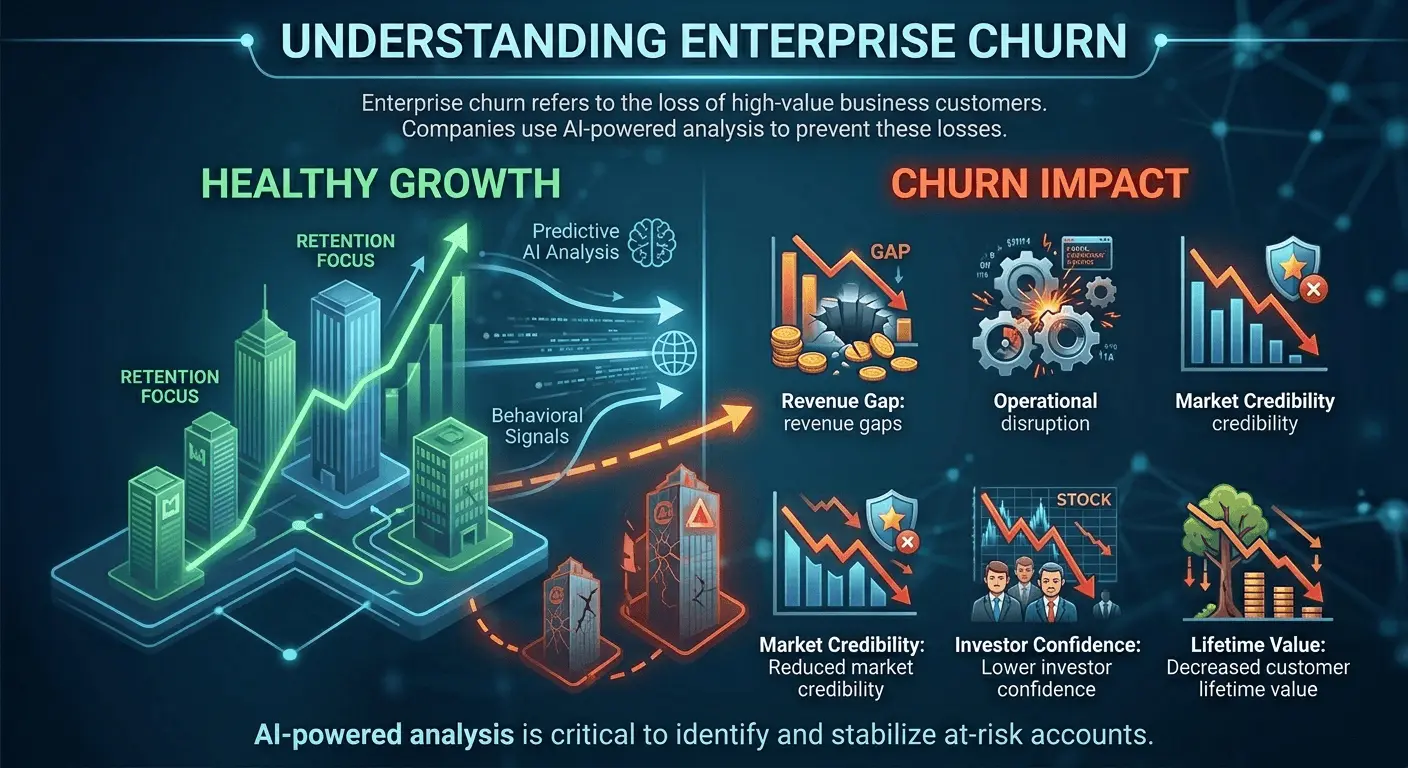
Enterprise churn refers to the loss of high-value business customers due to contract cancellations, reduced subscriptions, or migration to competitors. Companies use AI-powered account management to identify at-risk customers before they churn.
Unlike consumer churn, enterprise account losses create:
- Significant revenue gaps
- Operational disruption
- Reduced market credibility
- Lower investor confidence
- Decreased customer lifetime value
Why Is Enterprise Churn Increasing?
Several factors are accelerating churn rates globally.
Major Drivers of Enterprise Churn
| Churn Factor | Estimated Impact on Retention |
| Poor customer experience | 32% |
| Slow support response | 24% |
| Product complexity | 18% |
| Competitive pricing pressure | 15% |
| Lack of personalisation | 11% |
Enterprise Churn by Industry
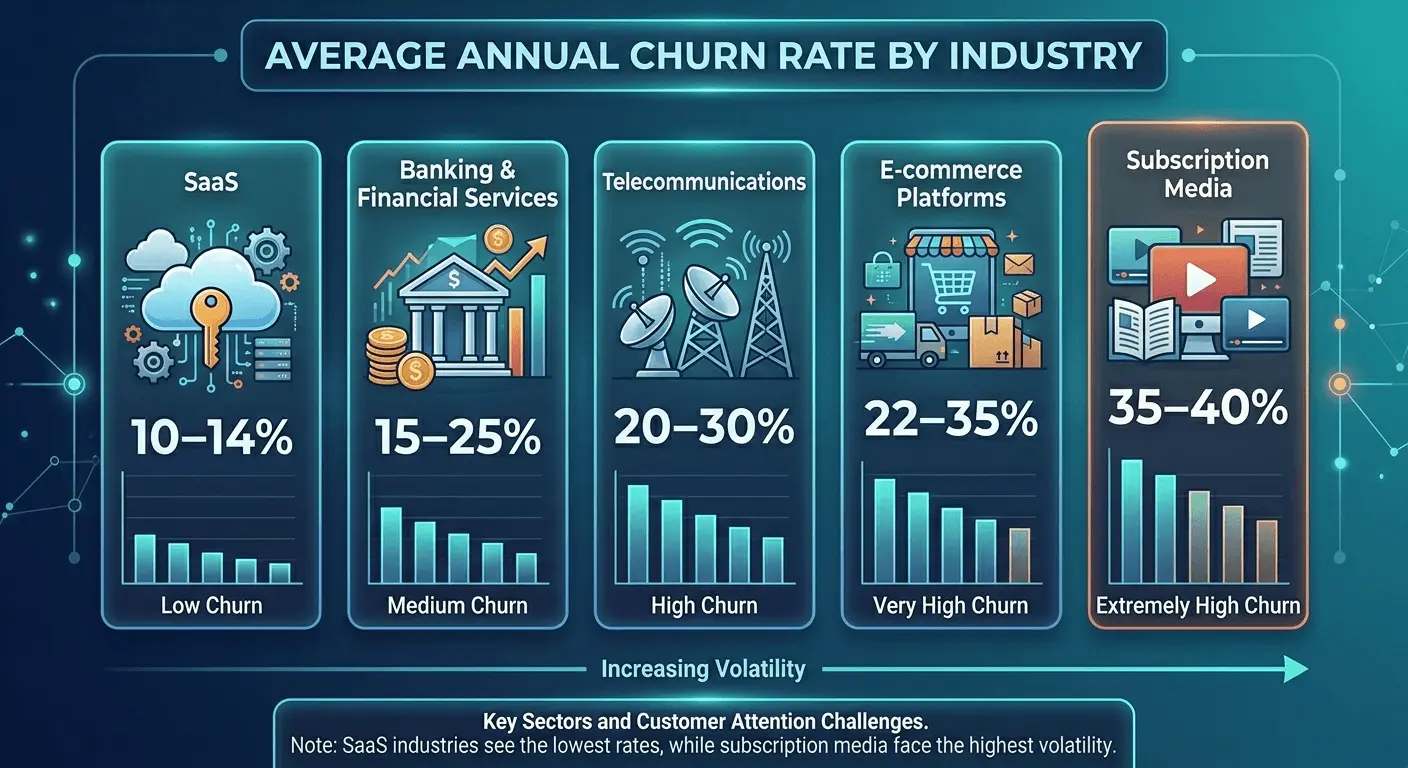
Annual Average Churn Rates
| Industry | Average Annual Churn Rate |
| SaaS | 10–14% |
| Telecommunications | 20–30% |
| Banking & Financial Services | 15–25% |
| E-commerce Platforms | 22–35% |
| Subscription Media | 35–40% |
AI-Enhanced Identity Resolution and Profile Unification
One of the most significant challenges in customer data management is accurately identifying the same individual across multiple touchpoints, devices, and channels. Traditional approaches rely heavily on deterministic matching using explicit identifiers, but these methods often create incomplete or fragmented customer profiles. According to Adfixus’s comprehensive analysis, deterministic matching alone typically identifies only 20-30% of customer relationships across digital channels, leaving organisations with a severely limited view of the customer journey and resulting in significant wasted marketing spend, often exceeding 35% of total digital advertising budgets. This limitation has driven organisations to seek more sophisticated approaches that leverage artificial intelligence to enhance identity resolution capabilities. B2B churn prediction models help companies identify business clients who are likely to leave.
Moreover, AI-driven identity resolution transforms this capability through advanced probabilistic matching models that examine behavioural patterns and implicit signals to determine likely matches, even without explicit identifiers. Adfixus reports that machine learning-based probabilistic matching can increase match rates by 2.5-3x compared to deterministic approaches alone, with advanced implementations achieving accuracy rates of 85-90% while maintaining a false positive rate below 5%. These models calculate match probability scores by analysing thousands of attributes and interaction patterns, enabling organisations to develop a significantly more comprehensive understanding of customer behaviour across touchpoints, with the most sophisticated implementations considering over 5,000 potential signals to make identity determinations. Customer lifetime value analytics allows businesses to understand the long-term value of each customer.
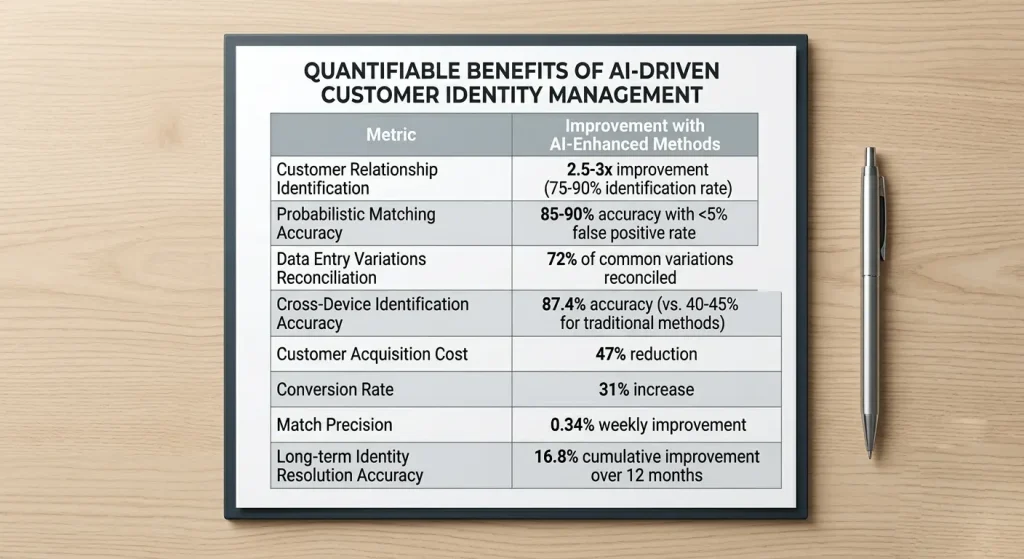
Quantifiable Benefits of AI-Driven Customer Identity Management
| Metric | Improvement with AI-Enhanced Methods |
| Customer Relationship Identification | 2.5-3× improvement (75-90% identification rate) |
| Probabilistic Matching Accuracy | 85-90% accuracy with <5% false positive rate |
| Data Entry Variations Reconciliation | 72% of common variations reconciled |
| Cross-Device Identification Accuracy | 87.4% accuracy (vs. 40-45% for traditional methods) |
| Customer Acquisition Cost | 47% reduction |
| Conversion Rate | 31% increase |
| Match Precision | 0.34% weekly improvement |
| Long-term Identity Resolution Accuracy | 16.8% cumulative improvement over 12 months |
The Evolution of Churn Prediction
Traditional churn management relied on:
- Manual CRM reviews
- Customer surveys
- Lagging indicators
- Historical reporting
- Static segmentation
Traditional vs Predictive AI Approaches
| Traditional Churn Analysis | Predictive AI Churn Analysis |
| Reactive | Proactive |
| Historical reporting | Real-time predictions |
| Manual segmentation | Automated clustering |
| Limited scalability | Enterprise scalability |
| Generic retention campaigns | Personalized interventions |
| Human-driven analysis | Machine learning insights |
How Predictive AI Identifies At-Risk Accounts
Predictive AI combines machine learning and behavioural analytics to uncover patterns associated with customer disengagement.
Core Data Sources Used by AI
Structured Data
- CRM records
- Subscription history
- Billing activity
- Product usage logs
Unstructured Data
- Emails
- Support tickets
- Call transcripts
- Customer feedback
- Chat conversations
Enterprise Churn Warning Signals
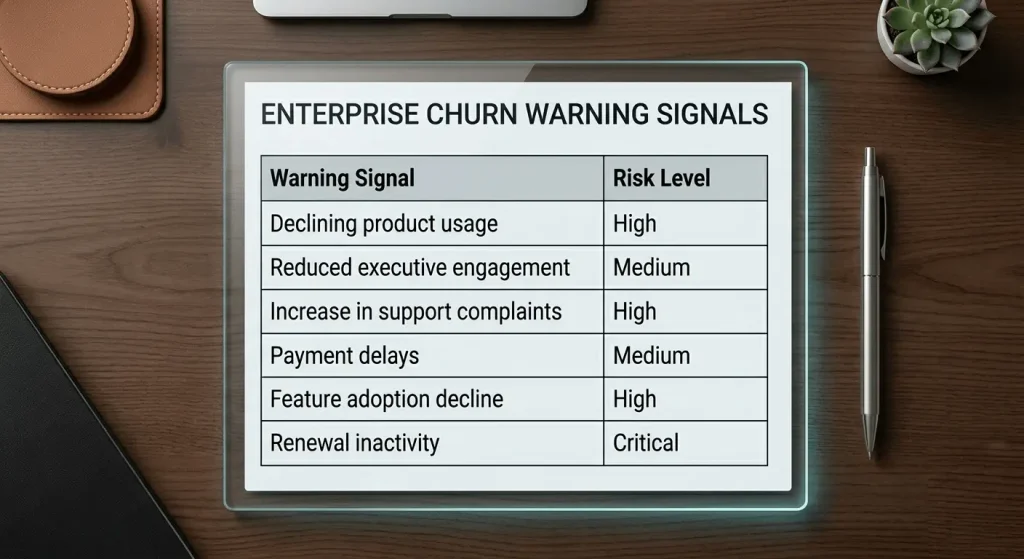
| Warning Signal | Risk Level |
| Declining product usage | High |
| Reduced executive engagement | Medium |
| Increase in support complaints | High |
| Payment delays | Medium |
| Feature adoption decline | High |
| Renewal inactivity | Critical |
Machine Learning Models Behind Churn Prediction
Customer churn is a big problem for businesses worldwide, resulting in lost revenue and decreased customer loyalty. It’s when customers stop doing business with a brand or service, often because of dissatisfaction or better options. Understanding the factors behind churn and implementing predictive strategies is essential for businesses. We use historical transaction data and customer behaviour to identify the major predictors for the indication of potential churn.
Predictive analytics for SaaS helps software companies improve customer retention and subscription renewals. And, We use different machine learning models, such as CatBoost and transformer-based Large Language Models (LLM), to improve the prediction. We also employ SMOTE to handle data balancing and eliminate class imbalance problems commonly seen in churn datasets. The ultimate goal of this research is not only to predict potential churners but also to propose actionable interventions that can improve customer retention rates. AI-driven churn systems rely on advanced machine learning algorithms.
Commonly Used AI Models
| AI Model | Purpose | Accuracy Potential |
| Logistic Regression | Basic churn classification | Moderate |
| Random Forest | Behavioral analysis | High |
| XGBoost | Predictive scoring | Very High |
| Neural Networks | Deep behavioural analysis | Advanced |
| LSTM Networks | Sequential prediction | Advanced |
A recent B2B SaaS churn study achieved an AUC-ROC score of 0.934 using Gradient Boosting models. Another financial institution study using Artificial Neural Networks achieved 97.5% prediction accuracy in churn forecasting. Customer behavior intelligence enables organisations to analyse how customers interact with products and services.
AI Accuracy Comparison
| Prediction Method | Average Accuracy |
| Manual forecasting | 52% |
| Traditional analytics | 67% |
| Machine learning models | 84% |
| Deep learning systems | 91% |
Deep Learning and Behavioural Intelligence
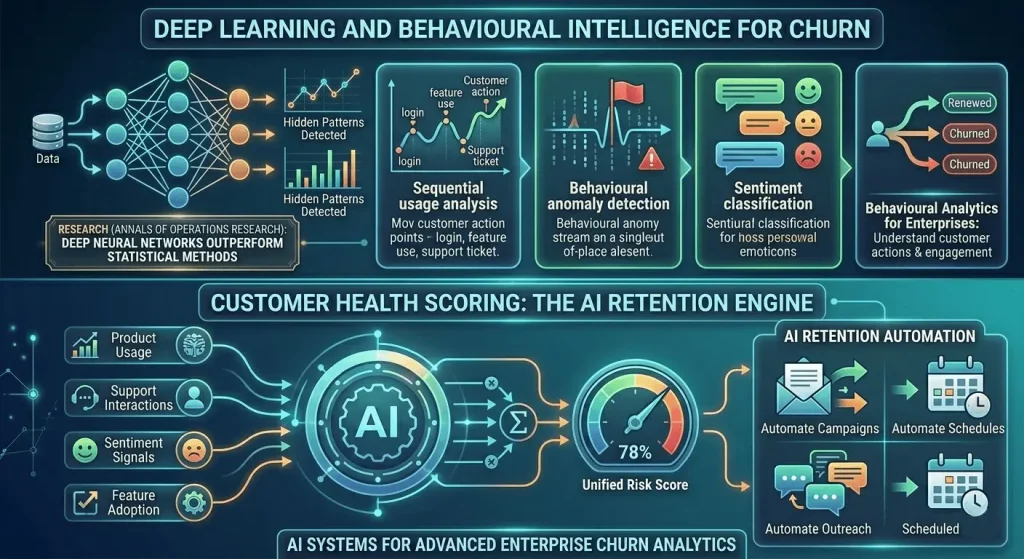
Research published in Annals of Operations Research demonstrated that deep neural networks outperform traditional statistical methods in identifying churn behaviour patterns. And yes, Deep learning churn prediction uses advanced AI models to forecast customer cancellations more accurately. Deep learning models are becoming increasingly valuable in enterprise churn analytics because they detect hidden customer behaviour patterns. Behavioural analytics for enterprises helps companies understand customer actions and engagement patterns.
- Deep Learning Capabilities
- Sequential usage analysis
- Behavioural anomaly detection
- Sentiment classification
- Customer journey forecasting
Customer Health Scoring: The AI Retention Engine
Customer health scoring is one of the most widely adopted predictive AI applications. AI systems combine multiple behavioural signals into a unified risk score. AI retention automation allows businesses to automate customer retention campaigns and outreach.
Customer Health Score Framework
| Metric | Weight |
| Product usage frequency | 30% |
| Support satisfaction | 20% |
| Renewal engagement | 25% |
| Payment consistency | 10% |
| Executive participation | 15% |
Customer Health Score Interpretation
| Score | Risk Category |
| 80–100 | Healthy |
| 60–79 | Moderate Risk |
| 40–59 | High Risk |
| Below 40 | Critical Risk |
Real-World Enterprise Case Studies
An enterprise SaaS provider analysed over 4,800 enterprise accounts using predictive AI models that processed more than 140 behavioural signals daily.
Results:
- 84% churn prediction accuracy
- $95 million ARR saved
- 90-day early churn detection
- 3x customer success efficiency improvement
Enterprise SaaS AI Retention Results
| Metric | Result |
| Accounts analyzed | 4,800 |
| Prediction accuracy | 84% |
| ARR retained | $95M |
| Early detection window | 90 days |
Telecom Churn Prevention
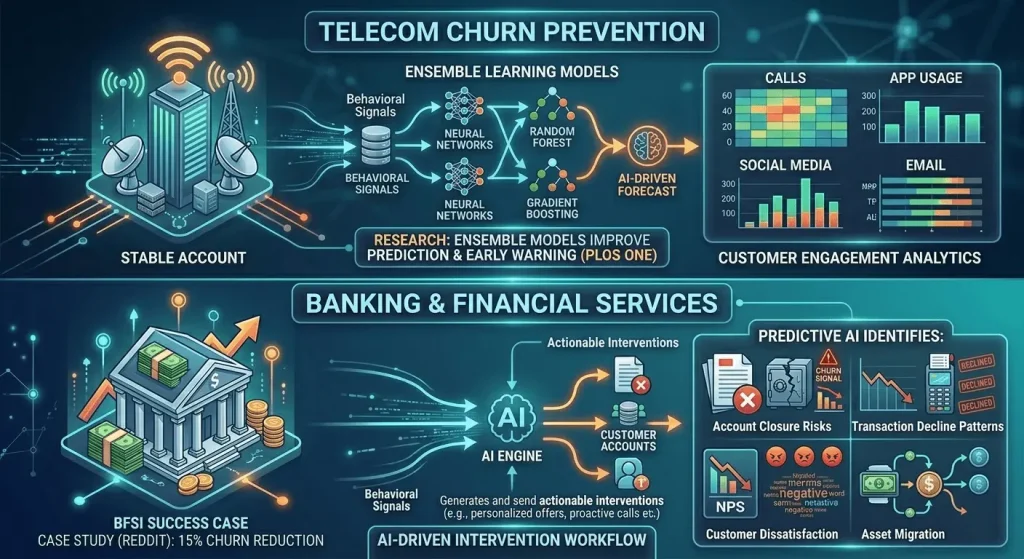
Telecom organisations increasingly rely on AI-driven churn forecasting due to extremely high churn rates. Research in PLOS One demonstrated that ensemble learning models significantly improve telecom churn prediction performance and early warning detection. Customer engagement analytics measures how customers interact with a company across different channels.
Banking & Financial Services
A recent Reddit case study involving BFSI predictive analytics reported a 15% reduction in customer churn after implementing AI-driven intervention workflows. Banks leverage predictive AI to identify:
- Account closure risks
- Transaction decline patterns
- Customer dissatisfaction
- Asset migration behavior
Churn Reduction Through AI Interventions
| Retention Strategy | Average Churn Reduction |
| Manual outreach | 5–8% |
| CRM automation | 10–12% |
| Predictive AI systems | 15–35% |
Sentiment Analysis and NLP in Churn Prediction
It is found that data mining techniques are more effective in predicting consumer churn from the research conducted over the past few years. Creating an efficient churn prediction model is an essential activity requiring a lot of work, right from determining appropriate predictor variables (features) from the large volume of available customer data to choosing an effective predictive data mining technique suitable for the feature set. Telecom Industries collect a large amount of customer-related data, such as customer profiling, calling patterns, and democratic data in addition to the network data they generate.
Based on the customer’s history of calling behaviour, there is a possibility to classify their attitude of either going away or not. Data mining techniques are found to be more effective in predicting churn from the research done over the past decade. The predictive modelling techniques in churn prediction are also considered to be more accurate. Enterprise AI forecasting helps organisations predict future business trends and customer behaviour.
Churn prediction systems and sentiment analysis using classification as well as clustering techniques to classify churn customers and the reasons behind the churning of telecom customers. In the telecom industry, we should generate a large amount of data on a daily basis. It is a very tedious task to mine such a kind of last data using specific data mining techniques, while hard to interpret the prediction using classical techniques. Various researchers have already described searching for work to eliminate churn from large data sets, fusion static as well as dynamic approaches, but still, such systems are facing many problems in the actual identification of churn.
Sometimes such telecommunication data may contain some churn and, and it is necessary to identify search problems. The successful identification of churn from large data provides effectiveness in customer relationship management (CRM). Revenue retention intelligence enables businesses to reduce customer churn and protect recurring revenue.
Sentiment vs Churn Probability
| Customer Sentiment | Churn Probability |
| Positive | 8% |
| Neutral | 24% |
| Negative | 61% |
| Highly Negative | 82% |
The Human-AI Collaboration Model
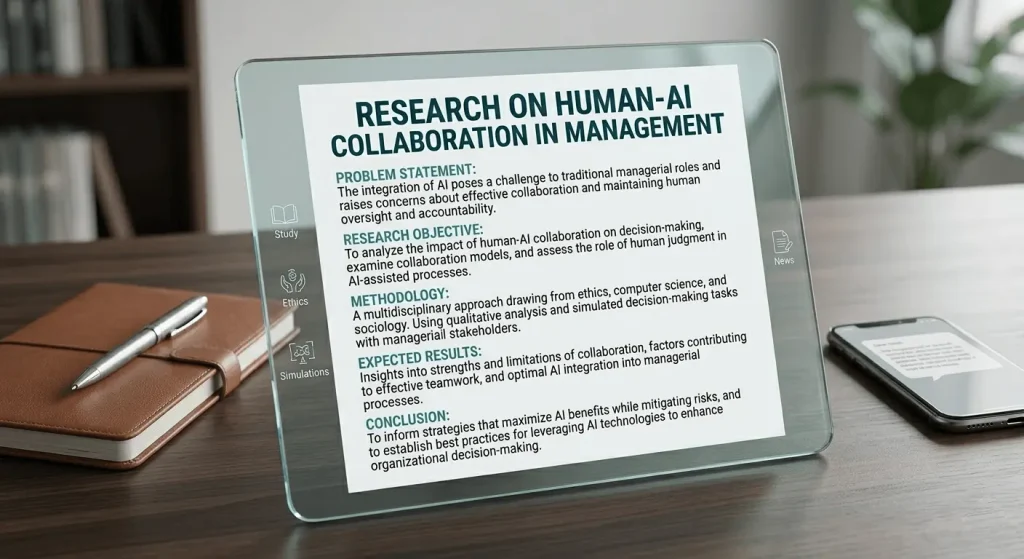
With the increasing integration of artificial intelligence (AI) technologies into various aspects of business operations, there is a growing interest in understanding how human-AI collaboration influences decision-making in management. This study aims to investigate the effects of such collaboration on decision-making processes within managerial contexts. Problem Statement: As AI systems become more sophisticated, there is concern about how they might affect traditional managerial roles and decision-making processes. Understanding the dynamics of human-AI collaboration in decision-making is essential for organisations to leverage these technologies effectively while ensuring human oversight and accountability.
The primary objective of this research is to analyse the impact of human-AI collaboration on decision-making in management. Specifically, the study aims to examine the effectiveness of different models of collaboration, identify factors influencing decision outcomes, and assess the role of human judgment in AI-assisted decision-making processes. Methodology: A multidisciplinary approach will be adopted, drawing on literature from ethics, computer science, and sociology. Qualitative analysis techniques will be employed to analyse existing case studies, ethical frameworks, and stakeholders from various managerial levels and industries will be involved in simulated decision-making tasks, allowing for the exploration of different collaboration models and decision contexts.
Results: The findings of this study are expected to provide insights into the strengths and limitations of human-AI collaboration in management decision-making. Analysis of decision outcomes, participant feedback, and performance metrics will shed light on the factors contributing to effective collaboration and the optimal integration of AI technologies into managerial processes. Conclusion: By understanding how human-AI collaboration influences decision-making in management, organisations can develop strategies to maximise the benefits of AI while mitigating potential risks. This research contributes to the growing body of knowledge on AI adoption in organisational contexts and informs best practices for leveraging AI technologies to enhance decision-making processes.
AI Handles:
- Pattern recognition
- Risk scoring
- Data processing
- Real-time forecasting
Humans Handle:
- Relationship building
- Negotiation
- Strategic communication
- Personalized engagement
Best Practices for Enterprise AI Retention
The biggest challenge facing archivists and records and information professionals today is how to deal with big data, which possesses the characteristics of volume, velocity, variety, veracity, value, and variability. Big data is so massive that it can’t be controlled using today’s database tools and analytics software techniques. It requires advanced technologies and techniques to automate routine processes. Even simple automation tools and workflows are not enough. Vendors are increasingly marketing their AI-enabled software and services to aid information professionals.
Build Unified Data Ecosystems
Integrate:
- CRM systems
- Billing platforms
- Customer support tools
- Product analytics
Focus on Explainability
Transparent AI increases enterprise trust.
Continuously Retrain Models
Behavioural trends evolve rapidly.
Align AI with Customer Success Teams
AI insights must connect directly to operational workflows.
Conclusion
The churn paradox represents one of the greatest hidden threats to enterprise growth. Organisations often prioritise customer acquisition while overlooking the warning signs of customer disengagement. Predictive AI changes this dynamic entirely. By leveraging machine learning, deep learning, behavioural analytics, and sentiment intelligence, enterprises can identify at-risk accounts before churn occurs. Instead of reacting after revenue disappears, organisations can proactively retain high-value customers through personalised interventions and data-driven engagement strategies. As enterprise AI continues evolving, predictive retention systems will become increasingly autonomous, accurate, and essential for sustainable business growth. The companies that master predictive customer intelligence today will dominate tomorrow’s competitive landscape.