
SaaS Cybersecurity | Micro-Segmentation Security | DevSecOps in SaaS
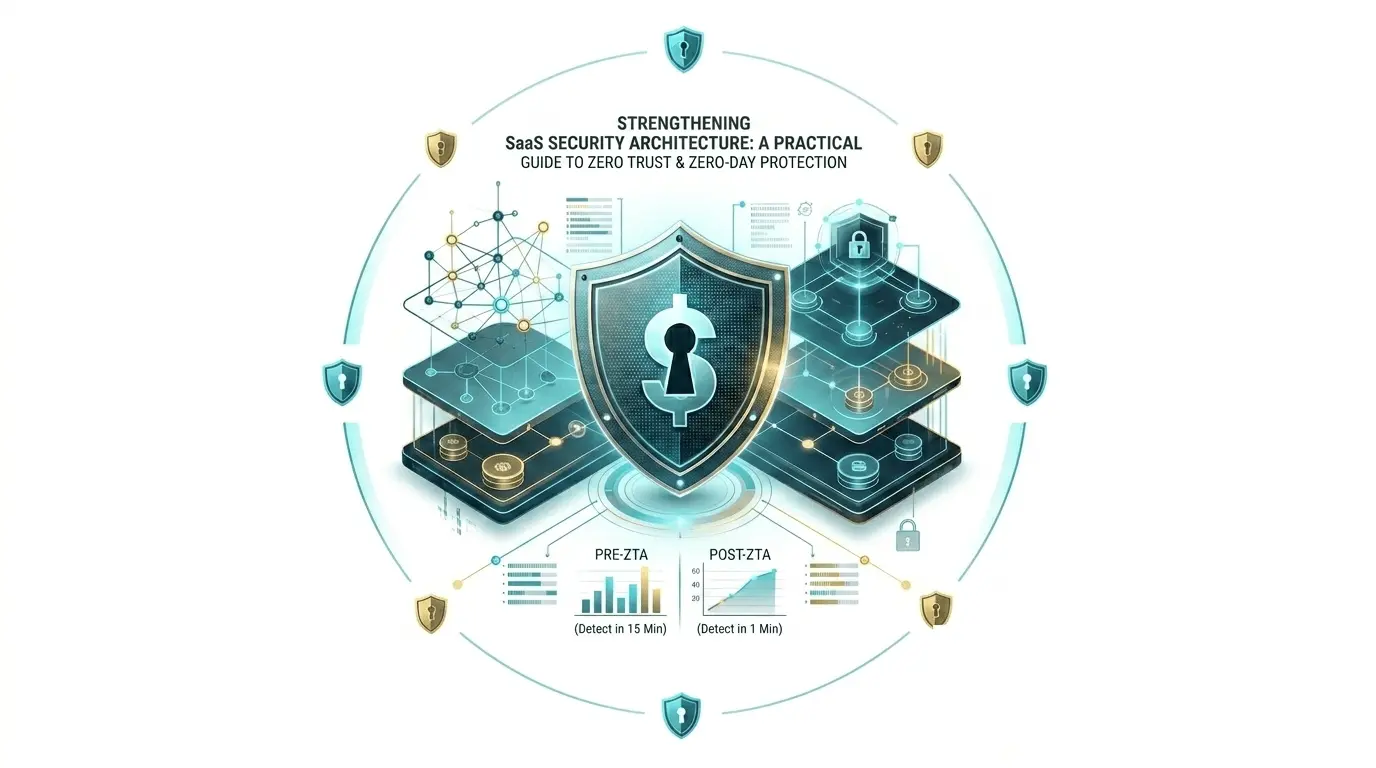
In the modern era, as businesses are rapidly adopting cloud-based tools, SaaS security architecture is becoming the top priority. Traditional security models that depend on the network boundaries are no longer effective against modern cyber threats, especially zero-day vulnerabilities. This paper explains how Zero Trust Architecture in SaaS helps organizations protect their systems using identity verification, encryption, and continuous monitoring. Enterprise SaaS Research helps businesses study cloud software solutions.
SaaS platforms like Google Workplace, Microsoft 365, and Slack transformed how companies operate. Cloud Security Architecture helps keep cloud systems safe by controlling access, protecting data, and monitoring for threats. But this convenience also introduces new security risks. In the past organization protected their systems using a “secure perimeter” approach, but now with remote work and cloud system that model no longer works.
Recent studies indicate that 94% of enterprises now operate in multi-cloud environments, increasing the likelihood of misconfigurations and vulnerabilities. Additionally, the average cost of a data breach reached $4.44 million globally in 2025, underscoring the financial implications of inadequate SaaS security.
Theoretical Foundation: Zero Trust Architecture
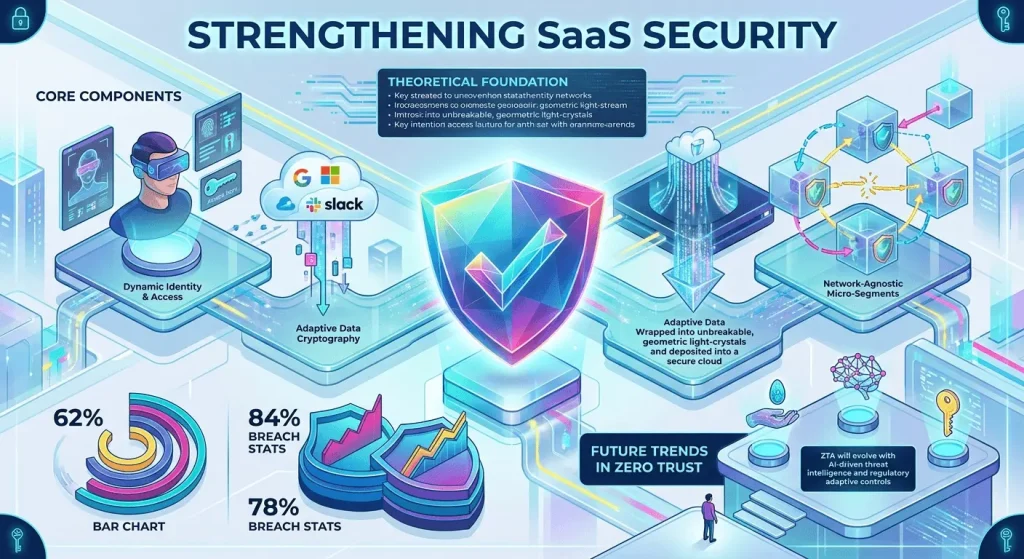
A zero trust architecture (ZTA) is an enterprise cybersecurity architecture that is based on zero trust principles and designed to prevent data breaches and limit internal lateral movement. This publication discusses ZTA, its logical components, possible deployment scenarios, and threats.
It also presents a general road map for organizations wishing to migrate to a zero trust design approach and discusses relevant federal policies that may impact or influence a zero trust Architecture. Zero Trust Architecture operates on the principle of never trust or always verify, eliminating the trust risk within network boundaries. Originally conceptualized by Forrester in 2010, ZTA has evolved into a foundational model for modern cybersecurity.
Core Components of Zero Trust
Here are the components that collectively enforce strict access controls and reduce attacks across the SaaS system:
- Identity and Access Management (IAM)
- Micro-Segmentation
- Software-Defined Perimeter (SDP)
- Continuous Monitoring and Analytics
Adoption and Effectiveness
Here are the statistics that validate Zero Trust as a critical strategy for enterprise SaaS security:
- 62% of organizations have adopted Zero Trust models
- 84% report reduced breach impact
- 78% of breaches could be prevented with full Zero Trust implementation
Future Trends in Zero Trust
As cyber threats become more organized and powerful, Zero Trust Architecture (ZTA) is expected to evolve more quickly with the growth of new technology and the need to address new challenges. Enterprise security strategy based on the concept of Never Trust, Always Verify will continue to be based on this concept, but will evolve as technology progresses, regulations change, and IT becomes more complex. Cyber Threat Prevention helps stop cyber attacks before they can harm systems or data.
Identity-Centric Security in SaaS
Traditional security models relied on network location, but SaaS systems require identity verification at every interaction point. Research shows that 90% of breaches involve compromised credentials and 65% of incidents are identity-related. In these highlights, the need for Multi-Factor Authentication (MFA), Behavioural analytics, and Device posture validation.
APIs are the major attack vector in SaaS environments. A 2023 study found that 60% of organizations identified API vulnerabilities as their primary risk. Implementing MFA at the API level and adopting standards such as OAuth 2.0 and OpenID Connect significantly reduces unauthorized access.
Encryption Standards in SaaS Security Architecture
API Security in SaaS helps protect data and services by ensuring only authorized users and applications can access them safely. Encryption is a foundational pillar of SaaS security, ensuring data confidentiality both in transit and at rest.
Data in Transit: TLS 1.3
TLS 1.3 is now the industry standard for secure communication, offering:
- Reduced handshake latency
- Forward secrecy
- Stronger cryptographic algorithms
Research shows that TLS 1.3 adoption has rapidly increased due to its improved security and performance characteristics.
Data at Rest: AES-256
AES-256 encryption is widely regarded as the minimum standard for enterprise compliance. Studies indicate:
- End-to-end encryption solutions (AES-256 + TLS 1.3) have a 75% adoption rate
- Effectiveness rating of 4.7/5 in preventing data breaches
Micro-Segmentation and Lateral Movement Prevention
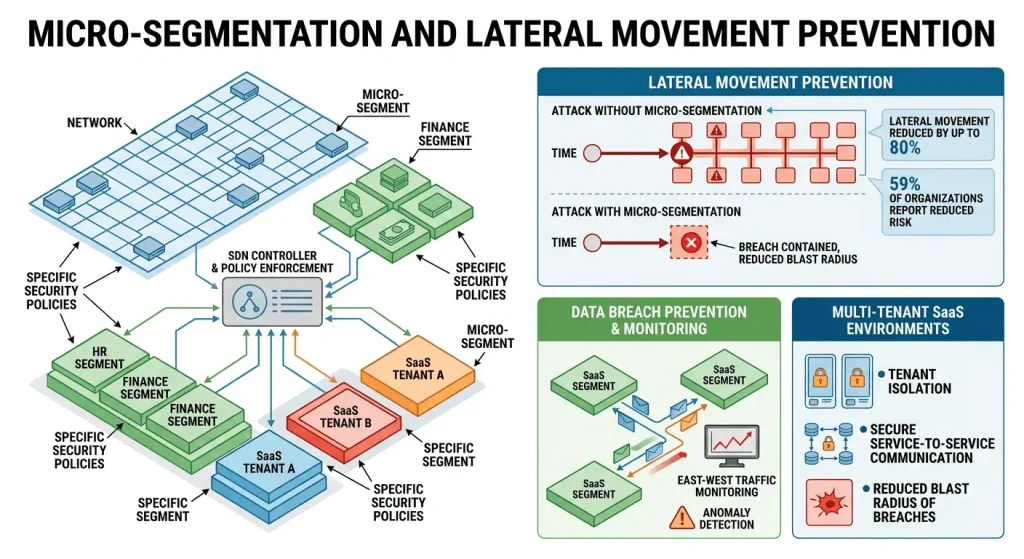
ZTA relies heavily on micro-segmentation, splitting the network into sub-segments with specific security policies applied to each one. This method reduces the chance of lateral movements taking place in the event of a breach, keeping attacks in a small portion of a network. Network zones must be clearly defined, and we must leverage Software-Defined Networking (SDN) to make policy enforcement and dynamic adjustments relatively simple. Another way of monitoring is east-west traffic, which is data flowing inside the internal network. This gives you another hint that there is some kind of anomaly or intrusion.
That is when effective microsegmentation still requires ongoing analysis and frequent updates to this policy to adapt to changing threats and the continuous needs. Data Breach Prevention helps protect sensitive information from being stolen or exposed.
Micro segmentation divides into the moment that consist into smaller, isolated segments, limiting attacker movement. This impact on security reduces lateral movement by up to 80% during attacks, and 59% of organizations report reduced lateral movement risks. In multi-tenant SaaS environments, micro-segmentation ensures:
- Tenant isolation
- Secure service-to-service communication
- Reduced the blast radius of breaches
Automated Security Patching and CI/CD Integration
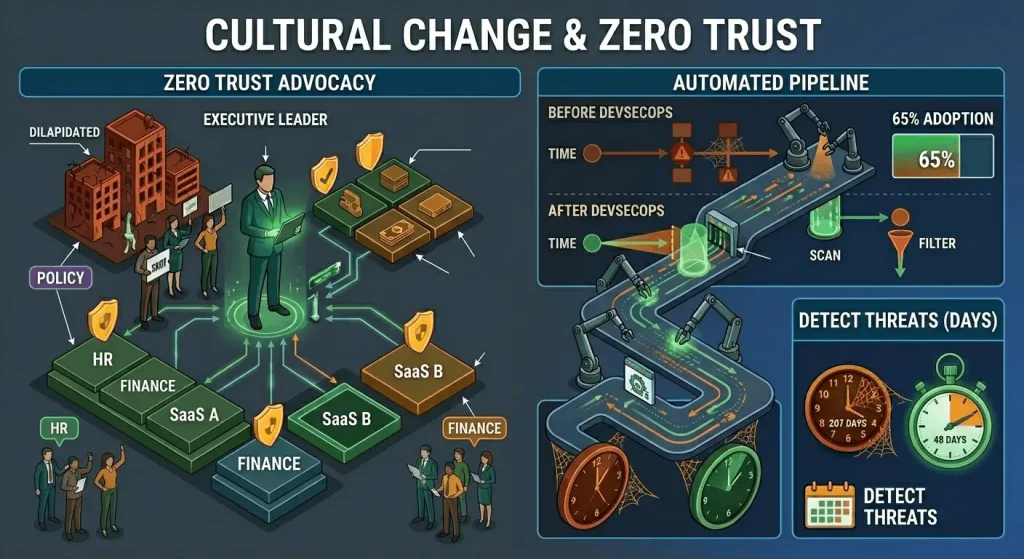
Changing the culture within the organization, on top of the technical measures, is needed for a successful Zero Trust implementation. Every employee at any level must have a security-first mindset and be aware of his/her part in making the environment secure. Trained staff can then suggest Zero Trust principles and best practices for secure behaviour during regular training sessions focused on how their current practices may expose them to cybersecurity risk. Continuous Monitoring Security helps keep systems safe by constantly checking for threats and unusual activity.
The Zero Trust should be supported by executive leadership by generating the funding and resources needed. If done right, it encourages technical and end users to work together for security and instills in an organization as a whole to take a unified approach towards defence. Modern SaaS relies on continuous deployment pipelines, making automated security scanning essential.
According to the research, 65% of organizations use DevSecOps practices, and automated scanning detects vulnerabilities before production deployment. And as per research Organizations implementing CI/CD security pipelines: Identify up to 90% of known vulnerabilities pre-deployment and reduce the mean time to detect threats from 207 days to 48 days.
Regularly Assess and Evolve Security Posture
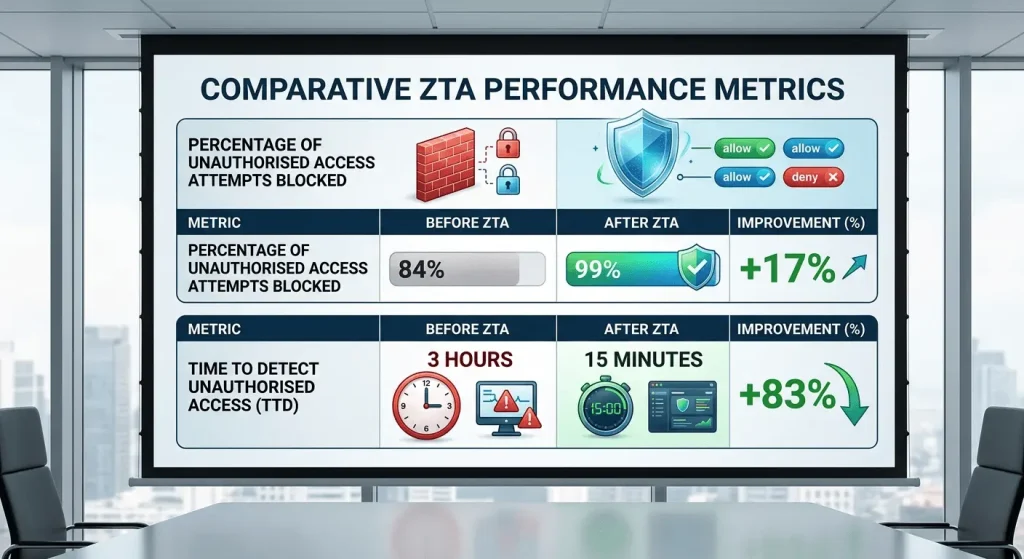
Because of the dynamic nature of cybersecurity threats, Zero Trust implementations must be continuously evaluated and improved. Regular penetration tests allow organizations to find and fix vulnerabilities before attackers can exploit them. Periodically, policies and procedures should be reviewed to make sure they still make sense and continue to work as strategists, business operators and regulatory requirements change.
By being informed about emerging threat trends and learning the lessons of high-profile breaches, an organization’s security posture is strengthened. Zero Trust strategy needs to be risk-aware and should adopt a proactive stance for assessment and evolution to continue to stay resilient when future challenges arise. If you want to learn more about Enterprise SaaS Research, visit SaaS & Systems Journal.
| Metric | Before ZTA | After ZTA | Improvement (%) |
| Percentage of Unauthorised Access Attempts Blocked | 84% | 99% | +17% |
| Time to Detect Unauthorised Access (TTD) | 3 hours | 15 minutes | +83% |
Zero-Day Vulnerabilities and Proactive Defense
Zero-day vulnerabilities are dangerous becuase its exploit the unknown weakness in the system. In zero day vulnerability, face challenges such as no existing patches or signatures, a high exploitation success rate and difficult detection. Zero Trust mitigates zero-day risks through Continuous authentication, Least Privilege Access And Behavioural anomaly detection. Organizations using Zero Trust report:
- 47% reduction in phishing attacks
- 62% fewer ransomware incidents
- 71% lower data exfiltration risk
Implementing Zero Trust Security in the Cloud
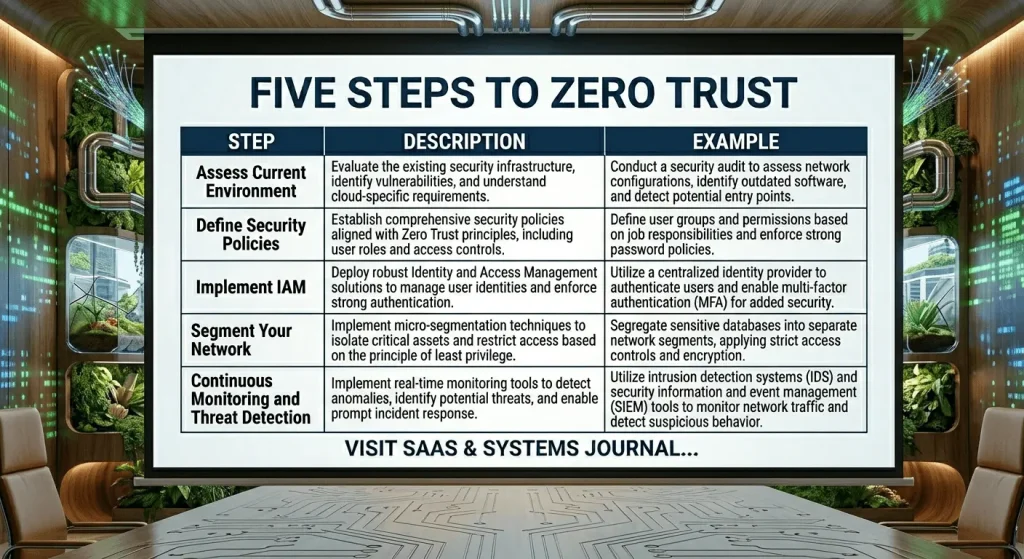
Implementing Zero Trust Security in the cloud means making sure no user or system is trusted automatically. Every access request is verified before permission is given. To do this successfully, organizations need proper planning and must follow best practices to improve their overall security.
Simple Steps to Implement Zero Trust Security
Final Words
This study emphasizes the critical need for modern security frameworks in SaaS environments as traditional perimeter-based approaches fail to address evolving cyber threats, particularly zero-day vulnerabilities. Zero Trust Architecture (ZTA), built on the principle of “never trust, always verify,” provides a comprehensive and adaptive solution through strict identity verification, least-privilege access, and continuous monitoring. It has the effect of reducing the attack surface, stopping lateral movement, and strengthening the organization’s resilience to increasingly advanced cyber threats. However, as enterprises struggle to deploy Zero Trust due to legacy system integration and costs, the benefits of Zero Trust extend far beyond the complexities, as it helps strengthen security and compliance.
What’s the Next Step?
At the moment, there is a clear direction that enterprise security will follow Zero Trust. Within the next generation of Zero Trust, in the midst of emerging technologies like artificial intelligence, multi-cloud frameworks, edge computing, and more, organizations are ready to push their Zero Trust implementations to the next level, ensuring continuity of security in a distributed and diverse landscape. Using Zero Trust principles and existing best practices, enterprises will be able to protect their assets, achieve compliance with regulatory requirements and cement a sound security posture for the future.
The attempt at the Zero Trust path is not a stroll in the park, but it is an essential pivot point in the safeguarding of the digital world. Researchers and practitioners can also share and publish similar studies on this site, and also have the freedom to post their searches and papers here. SaaS & Systems Journal is an independent digital publication dedicated to the advancement of enterprise technology, B2B software architecture, and cloud infrastructure research. We provide data-driven insights for C-suite executives and technical decision-makers.
Frequently Asked Questions
1. How does Zero Trust Architecture mitigate zero-day vulnerabilities in SaaS environments?
Zero Trust Architecture mitigates zero-day threats by eliminating implicit trust and enforcing continuous verification of users, devices, and workloads. Even if a vulnerability is exploited, controls such as least-privilege access, micro-segmentation, and behavioral analytics restrict attacker movement and limit damage. Unlike signature-based defenses, ZTA relies on real-time context and anomaly detection, making it highly effective against unknown or emerging threats.
2. What role do modern encryption standards like TLS 1.3 and AES-256 play in SaaS security architecture?
TLS 1.3 secures data in transit by providing forward secrecy, reduced latency, and stronger cryptographic handshakes, while AES-256 ensures robust protection of data at rest. Together, they create end-to-end encryption that prevents interception, tampering, and unauthorized access. These standards are essential for compliance and are foundational to securing APIs, user data, and service-to-service communication in SaaS platforms.
3. Why is integrating DevSecOps with CI/CD pipelines critical for SaaS security?
Integrating DevSecOps into CI/CD pipelines ensures that security is embedded throughout the software development lifecycle rather than applied post-deployment. Automated security testing (SAST, DAST, and dependency scanning) identifies vulnerabilities early, reduces remediation costs, and accelerates secure releases. This proactive approach significantly decreases the risk of deploying exploitable code into production environments.
References
Eduardo B. Fernandez and Andrei Brazhuk, “A Critical Analysis of Zero Trust Architecture (ZTA),” Computer Standards & Interfaces, vol. 89, 2024
Abdul Rahman et al., “Implementation of Zero Trust Security in MSME Enterprise Architecture: Challenges and Solutions,” Synchronous: Informatics Engineering Journal and Research, vol. 8, no. 3, pp. 2077-2087, 2024
https://wifitalents.com/zero-trust-statistics
https://sarcouncil.com/download-article/SJECS-2023.pdf
https://www.ijcttjournal.org/2025/Volume-73/Issue-6/IJCTT-V73I6P107.pdf
https://nvlpubs.nist.gov/nistpubs/specialpublications/NIST.SP.800-207.pdf