
Summary: Over the past decades, the prompt expansion of cloud computing has changed the shape of enterprise IT. In 2026, the organizations that have adopted cloud have transitioned from a strategic advantage to a business necessity. This research paper will provide you with a backward record of enterprise IT spending trends. Also, you will get to know about trends, financial patterns, cost challenges, and emerging governance frameworks like FinOps. Recent numbers, field analyses, and scholarly work form the base. Budget choices in cloud enterprise spending come under review. Spending shifts appear where AI steps in. Pressure builds as teams seek tighter control over costs.
2026 State of the Cloud: A Retrospective on Enterprise Spending
Every large company depends on remote systems. These days, the internet’s hidden computers do more than cut expenses; they shape how businesses change and grow. Instead of just saving money, such tools power big shifts in digital transformation cloud strategies. Across fields, organizations build flexibility and fresh ideas using network-based services. One big shift in tech budgets started with the cloud offering room to grow, move fast, and stay cheap. Most companies now build software differently because of it. A look at global trends shows that ninety-four percent will rely on cloud systems by 2026. This change touches how decisions are made across businesses. By 2026, 94% of enterprises globally use cloud services, demonstrating near-universal adoption.
Yet things got trickier when everyone started using the cloud. Different setups like IaaS, PaaS, and SaaS mix together, sitting alongside older systems kept around for rules or speed. On top of that, AI, gadgets everywhere, and processing at the edges push more load into digital space – using far more power, room for files, and movement across networks. By 2026, this pattern will drive how money flows upward fast. Firms face growing bills, unclear invoices, and oversight gaps they can’t ignore anymore.
Evolution of Enterprise Cloud Spending
Most companies used to handle tech needs themselves. They bought real machines, servers, network boxes, and storage units, and stacked them in office closets or back rooms. Running simple tools such as email or shared folders meant high costs on gear, plus constant care from internal staff. It became important to make an enterprise cloud budget.
By 2026, cloud enterprise spending will settle into steady patterns across big businesses. Spending habits shift slowly but surely toward online infrastructure instead of metal and wires. What once demanded space and people now runs quietly through remote networks.
1. Global Market Growth
Cloud enterprise spending has reached unprecedented levels. Global cloud expenditure hit approximately $723 billion in 2025 and continues to grow rapidly. Cloud cost optimization will become a hot trend in 2026 as it makes organisation workflow 10x better. Forecasts suggest that public cloud market growth spending will surpass $1 trillion in 2026, marking a major milestone in enterprise investment.
2. Enterprise Budget Allocation
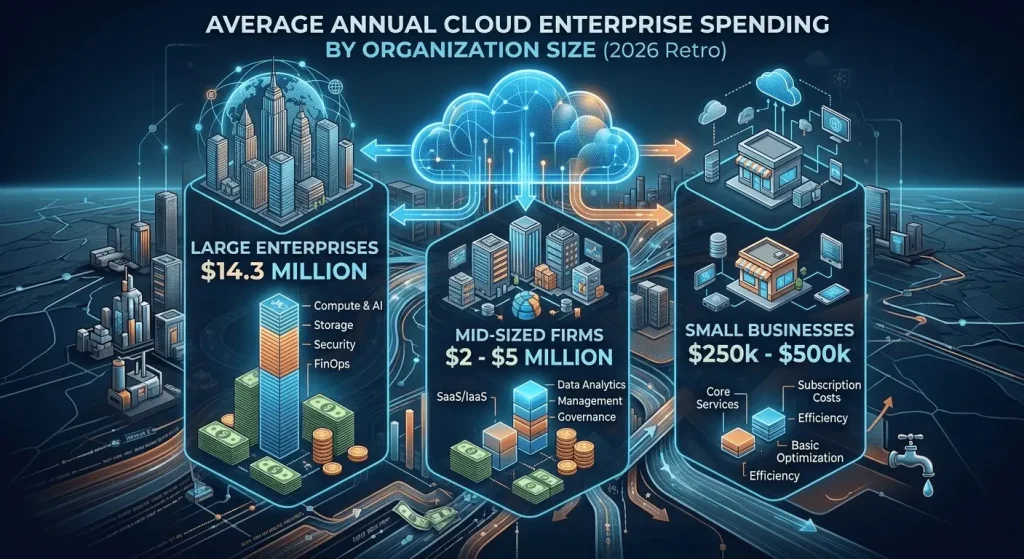
Before cloud organizations had to build and maintain their own IT backbone, buying physical servers, networking equipment, and storage drives and then installing them in on-site server rooms. Even basic functions like email, file sharing, or internal software systems required significant investment in hardware and a dedicated IT team to keep everything up and running. The following figures indicate a steady increase in cloud enterprise spending budgets, with over 50% of CIOs planning to increase spending by at least 10% in 2026.
| Organizational size | Average Annual Cloud Spend |
| Large Enterprises | $14.3 million |
| Mid Sized Firms | $2-5 million |
| Small Businesses | $250k-500k |
Cloud Adoption and Usage Patterns
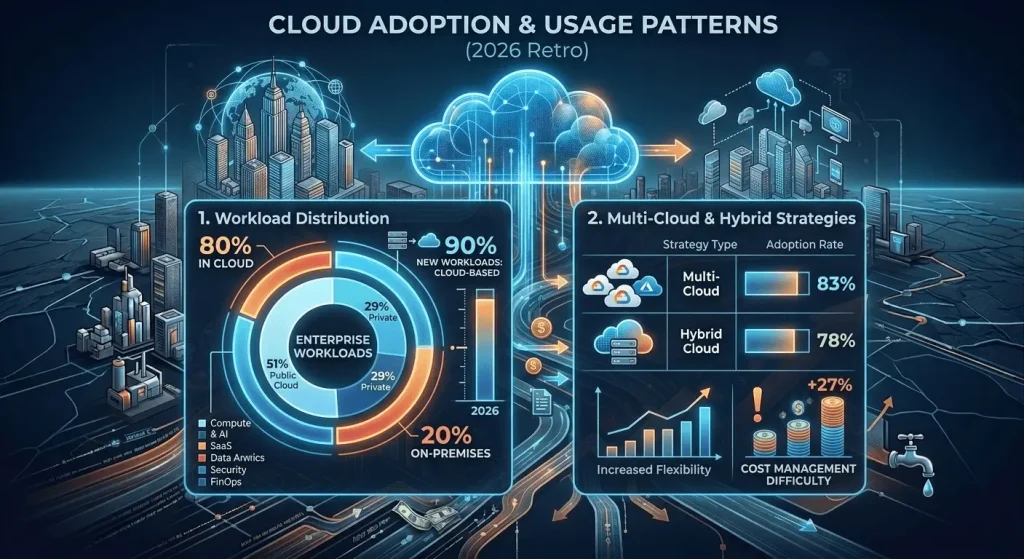
Cloud adoption and usage patterns involve a strategic shift toward hybrid/multi-cloud environments, AI integration, and serverless architectures to improve agility and scalability.
1. Workload Distribution
The cloud is now the dominant infrastructure for enterprise workloads:
- 80% of enterprise workloads run in the cloud
- 51% in public cloud, 29% private, 20% on-premises
- 90% of new workloads expected to be cloud-based by 2026
2. Multi-Cloud and Hybrid Strategies
The Multi-cloud and hybrid strategies enable organizations to optimize performance, enhance resilience, and avoid vendor lock-in by diversifying cloud infrastructure cost. Multi-cloud uses public clouds, and hybrid strategies combine private structure with public clouds to balance control and scalability. Multi-cloud strategy statistics have increased flexibility but also introduced cost complexity. Studies show that multi-cloud environments increase cost management difficulty by 27%.
| Strategy Type | Adoption Rate |
| Multi-cloud | 83% |
| Hybrid Cloud | 78% |
Cost Structure of Cloud Spending
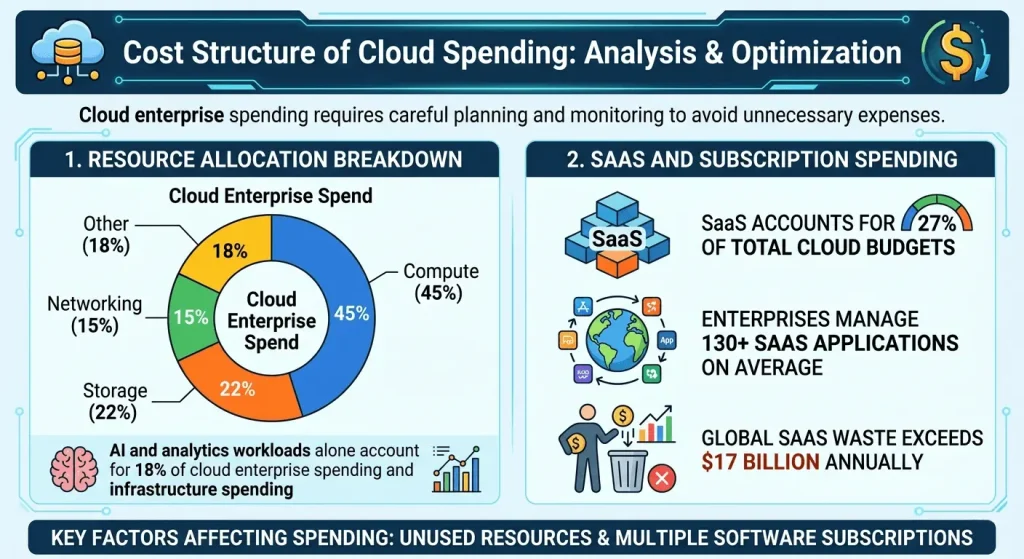
Cloud enterprise spending is mainly divided into compute, storage, and networking costs, with compute taking the largest share due to application processing needs. Storage costs grow as companies handle increasing amounts of data, while networking expenses arise from data transfer and connectivity. In addition, factors like unused resources and multiple software subscriptions can increase overall spending. This structure shows that managing cloud costs requires careful planning and monitoring to avoid unnecessary expenses.
1. Resource Allocation Breakdown
AI and analytics workloads alone account for 18% of cloud enterprise spending and infrastructure spending, reflecting their growing importance.
| Resource Type | Percentage of Spend |
| Compute | 45% |
| Storage | 22% |
| Networking | 15% |
| Other | 18% |
2. SaaS and Subscription Spending
Following is the SaaS spending analysis:
- SaaS accounts for 27% of total cloud budgets
- Enterprises manage 130+ SaaS applications on average
- Global SaaS waste exceeds $17 billion annually
Key Challenges in Cloud Spending
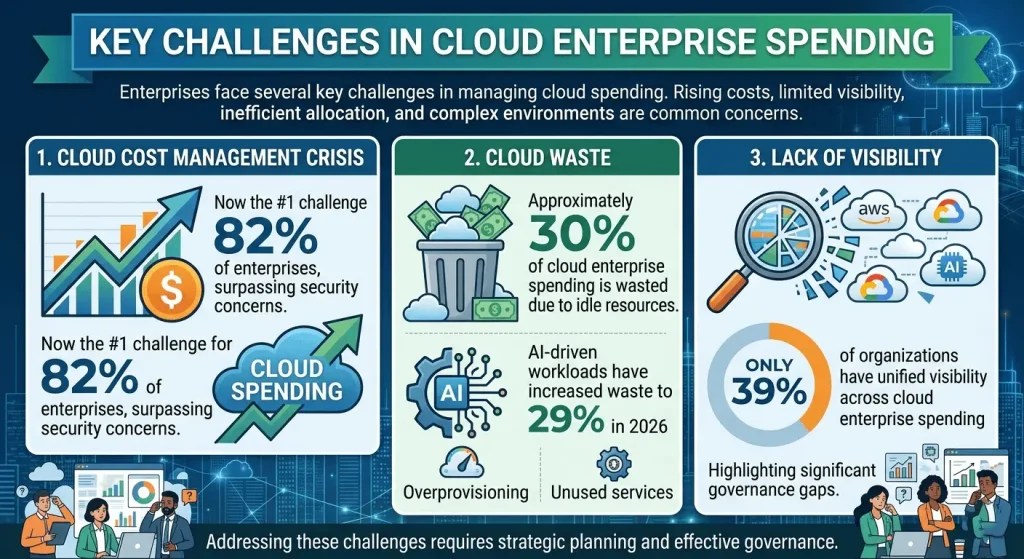
Enterprises face several key challenges in managing cloud enterprise spending. Rising costs is one of the most significant concerns. Many organizations struggle with limited visibility into their usage. This makes it difficult to track where money is being spent. Also, inefficient resource allocation such as overprovisioning or unused services leads to unnecessary expenses. The complexity of multi-cloud environments and increasing reliance on AI-driven workloads.
1. Cloud Cost Management Crisis
Cloud cost management strategies is now the #1 challenge for 82% of enterprises, surpassing even security concerns.
2. Cloud Waste
- Approximately 30% of cloud enterprise spending is wasted due to idle resources
- AI-driven workloads have increased waste to 29% in 2026
3. Lack of Visibility
Only 39% of organizations have unified visibility across cloud enterprise spending, highlighting governance gaps.
The Role of AI in Cloud Spending
Artificial intelligence is the single biggest driver of cloud enterprise spending in 2026. AI has transformed cloud from a utility into a strategic investment layer, but it has also introduced unpredictable cost dynamics. AI cloud spending impact is given:
- AI workloads consume up to 30% of cloud compute capacity
- Enterprise software budgets increased 58% YoY due to AI adoption
- AI tools are increasing vendor pricing by 20–37%
Emergence of FinOps and Cost Optimization
Now teams handle cloud enterprise spending differently due to FinOps’ emergence. Instead of one department setting limits, people across units take ownership. This change brings clearer insight into spending as it happens. Working together closely, tech builders talk directly with money planners. Decisions get made faster because information flows without delays. Costs stay under control when everyone understands their role. Results improve since efforts match actual needs. Big surprises on bills happen less often now
FinOps Adoption
- 70% of enterprises now have FinOps teams
- Adoption grew 46% in 2025
Benefits of FinOps
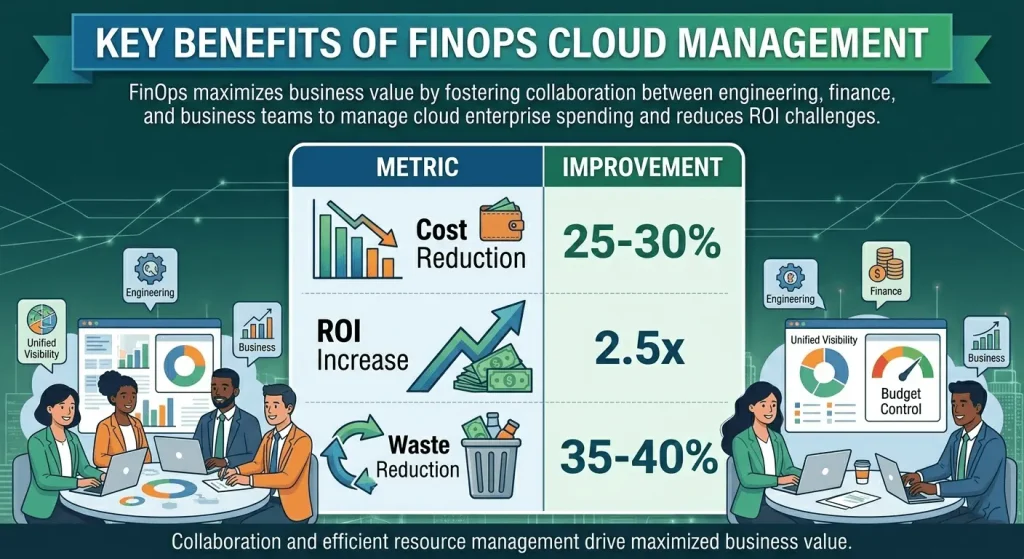
FinOps cloud management maximizes business value by fostering collaboration between engineering, finance, and business teams to manage cloud enterprise spending. It reduces the cloud ROI challenges. Following are some of its key benefits:
| Metric | Improvement |
| Cost Reduction | 25-30% |
| ROI Increase | 2.5x |
| Waste Reduction | 35-40% |
Academic Perspective
Research such as “ABACUS: A FinOps Service for Cloud Cost Optimization” highlights the importance of automated budget enforcement and predictive cost analysis in improving cloud efficiency.
Regional Cloud Spending Trends in 2026
Global public cloud enterprise spending is projected to reach $723.4 billion in 2025, driven by AI and hybrid cloud adoption. North America leads with 40% of global revenues, while the Asia-Pacific region shows the fastest growth (22.2% CAGR). Major investments focus on IaaS, SaaS, and AI-powered infrastructure, with AWS, Microsoft, and Google controlling 63% of the market. Following figures demonstrate the global expansion of cloud economics research:
| Region | Share of Global Spending |
| North America | 49% |
| Europe | 24% |
| Asia Pacific | Fastest growing (18% CAGR) |
| Middle East & Africa | $20B annually by 2026 |
Discussion
The 2026 cloud landscape reveals a paradox: while the cloud enables innovation and scalability, it also introduces financial complexity and inefficiency. Enterprises are no longer asking whether to adopt cloud, but rather how to optimize it.
Three major shifts define this era:
- From adoption to optimization
- From cost-saving to value generation
- From IT decision to business strategy
Why is Cloud Computing Important?
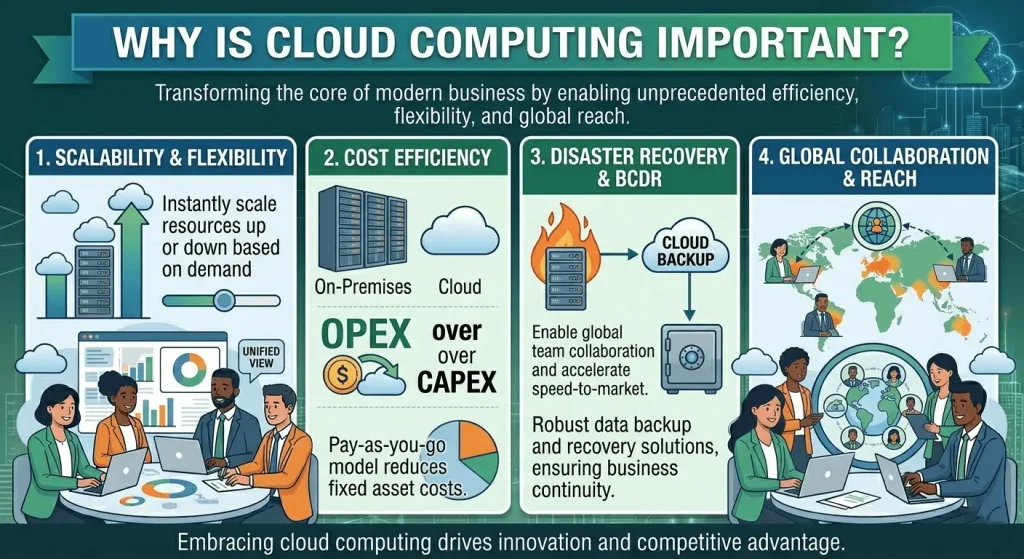
Cloud usage is no longer a metric of innovation; it’s the infrastructure of modern business. Nearly every workload now touches the cloud, and usage continues to grow exponentially across all industries. But with growth comes complexity: sprawl, waste, and compliance gaps challenge even the most mature cloud programs.
The statistics show a clear shift: organizations are adopting automation, FinOps, and governance frameworks to align cloud enterprise spending usage with business goals. Efficiency and security are now as important as scalability. It is important for enterprise IT spending trends. Those who master usage optimization, standardization, and visibility will unlock the real promise of cloud-cost-efficient, agile, and resilient digital ecosystems.
Conclusion
Now in 2026, cloud computing is considered the backbone of enterprise IT. But it has a high financial demand that is also significant. AI, multi-cloud strategies, and SaaS ecosystems have driven spending to record levels. With this, they create new challenges in governance and cost control.
The cloud has become the default platform for innovation, operations, and collaboration across the world. Only those organizations will get positioned to maximize the value of their cloud in the coming years who have invested in FinOps, automation, and strategic planning.
Publish Your Research with SaaS and Systems Journal
If you are someone who is interested in the latest enterprise trends and wants to know the latest technologies, you need to read our journals. We aim to provide you with the latest hot technologies that make an organization top-notch. SaaS and Journal is a guide for entrepreneurs to make their organisation’s growth smooth.
If you like to write or explore things like cloud computing, AI, or enterprise technology, you can write on our platform. SaaS and Journal invite researchers, professionals, or students to publish their research work with us. You can share your ideas, contribute to a trend, and share industry knowledge to help other organization owners.
Frequently Asked Questions
1. How do multi-cloud and hybrid architectures impact enterprise cloud cost management?
Multi-cloud and hybrid environments increase flexibility and resilience but also introduce cost complexity. Each cloud provider has different pricing models for compute, storage, and data transfer, making it harder to track and optimize spending. Without centralized visibility, organizations face challenges like duplicated resources, inconsistent billing, and inefficient workload placement. To manage this, enterprises use unified monitoring tools, cost allocation tagging, and governance policies to control spending across environments.
2. What are the key components of an effective FinOps strategy in cloud environments?
An effective FinOps strategy focuses on real-time cost visibility, cross-team collaboration, and continuous optimization. It includes practices such as cost allocation (tagging resources by team or project), budgeting and forecasting, automated scaling, and rightsizing of resources. Advanced FinOps models also use predictive analytics to forecast future cloud usage and spending. By integrating finance with engineering decisions, organizations can balance performance, scalability, and cost efficiency.
3. How does AI-driven workload demand influence cloud infrastructure costs?
AI workloads significantly increase cloud costs because they require high-performance compute resources such as GPUs, large-scale storage, and high-bandwidth networking. Training machine learning models consumes substantial compute capacity, while real-time inference adds ongoing operational costs. Additionally, AI workloads often run continuously and scale dynamically, leading to unpredictable billing patterns. To manage this, organizations implement workload scheduling, resource optimization, and cost monitoring tools to control AI-related cloud expenses.