
Cloud Infrastructure Intelligence | IT Decision Maker Insights | B2B Software Architecture
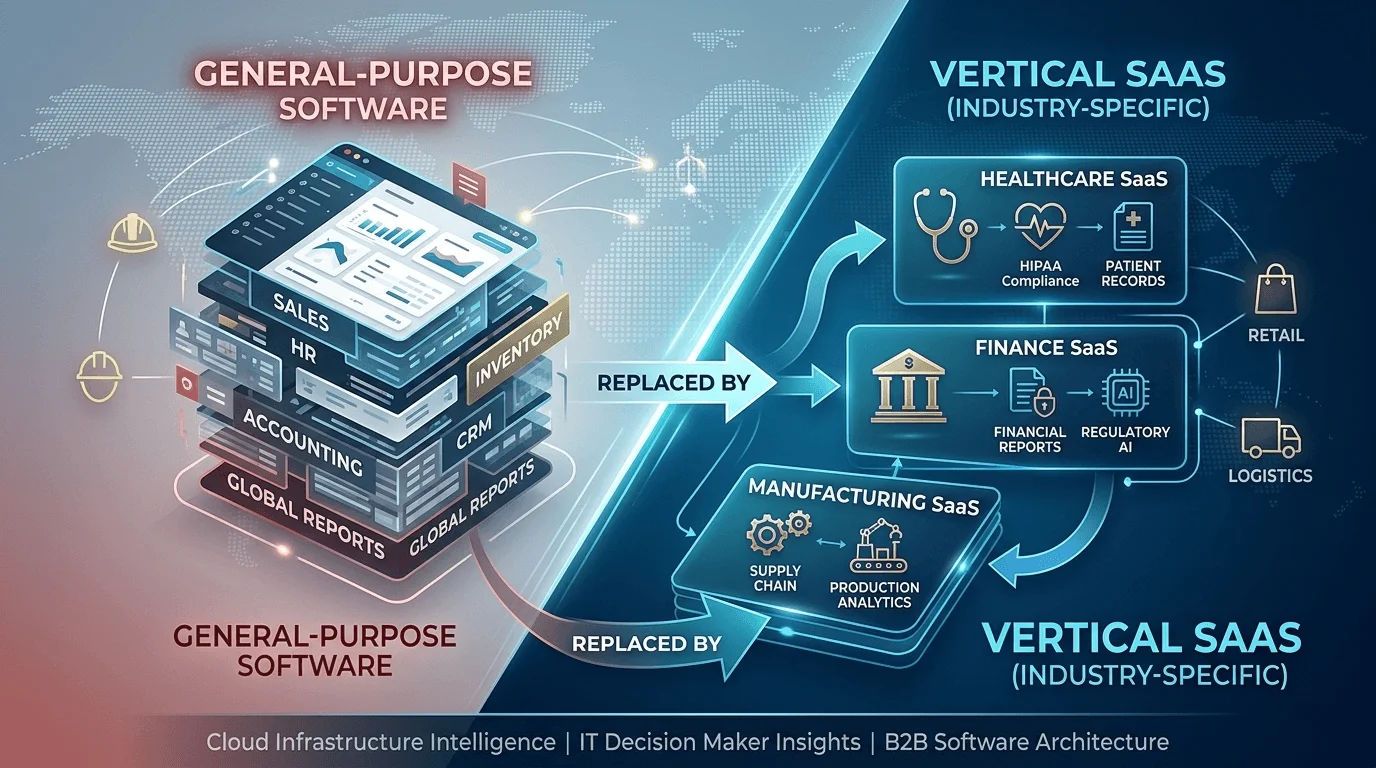
Software-as-a-Service (SaaS) has received significant attention recently as one of the three components of cloud computing. Vertical SaaS extends the SaaS model by offering specialized software solutions adaptive to specific industries and focuses on the unique requirements of a particular sector. Vertical SaaS provides a solution that comes with pre-build features and functionalities designed to address industry specific challenges and workflow.
Unlike horizontal SaaS, which serves a broad range of users with generalized features. Vertical SaaS provides solutions for a specific problem in the industry. Additionally, pre-configured integrations are also included in it with industry-standard APIs. This enables a seamless data exchange and streamlined operations. It is built to handle the unique compliance, workflow, and terminologies of a single sector.
Why are Horizontal SaaS Platforms Losing Relevance?

Horizontal SaaS has historical success and has been a top-notch choice for decades. But now they are increasingly constrained by structural limitations. The industry is transforming into niche horizontal SaaS, as it provides ready-to-use workflows, helping leaders and investors move away from general tools. Horizontal SaaS is losing relevance due to the transformative impact of AI.
1. Feature Bloat and Underutilization
One of the most significant factors leading to horizontal SaaS losses is feature bloat. Research papers indicate that users pay for 80% of features but use only 20% of them. Investors use only limited features that are required for the problem solution. This creates unnecessary complexity, which reduce useability and inefficient resource allocation.
2. High Customization and Integration Costs
To solve many problems or make the workflow smooth, investors pay a high cost to customize it. Customization often involves significant configuration and integration efforts. This makes the solution flexible but complex. It not only increases cost but also introduces operational risk and delays.
3. Data Models and Integrations
Horizontal SaaS uses generic data models that require adaptation for industry-specific applications. Integration capabilities are broad, supporting various third-party tools. But it often necessitates custom development to fit specific industry requirements.
The Rise of Vertical SaaS as a Structural Shift
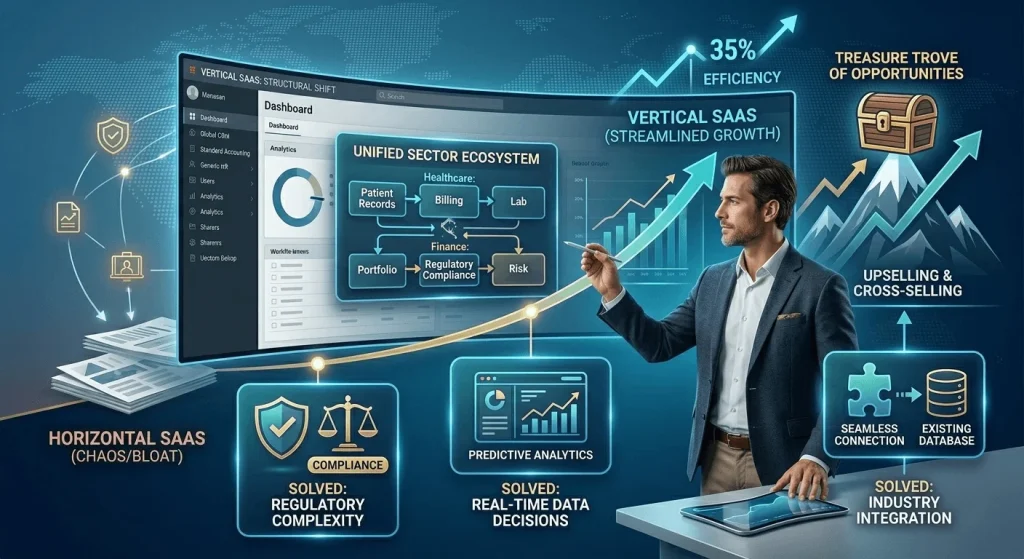
Vertical SaaS creates an ecosystem of solutions meticulously crafted for a specific industry solution. With this, investors are able to find out their customers’ approaches and needs, which helps them to fit into their daily work routine. Vertical SaaS unlocks a treasure trove of opportunities for upselling and cross-selling.
Horizontal SaaS has many features, but only a few are used, while now companies want only those tools that are useful. Vertical SaaS provides solutions to companies for their specific problems. It offers an all-in-one solution, nullifying the need for customers to grapple with multiple disparate tools. This results in a streamlined workflow and heightened efficiency.
Lastly, vertical SaaS smartly sidesteps the configuration challenges often associated with horizontal software. This shift is driven by factors of horizontal SaaS, which are now solved by vertical SaaS. These factors include:
- Increase in regularity complexity
- High demand for real-time, data-driven decision-making
- Need for seamless integration with industry-specific systems
The Competitive Advantages of Vertical SaaS
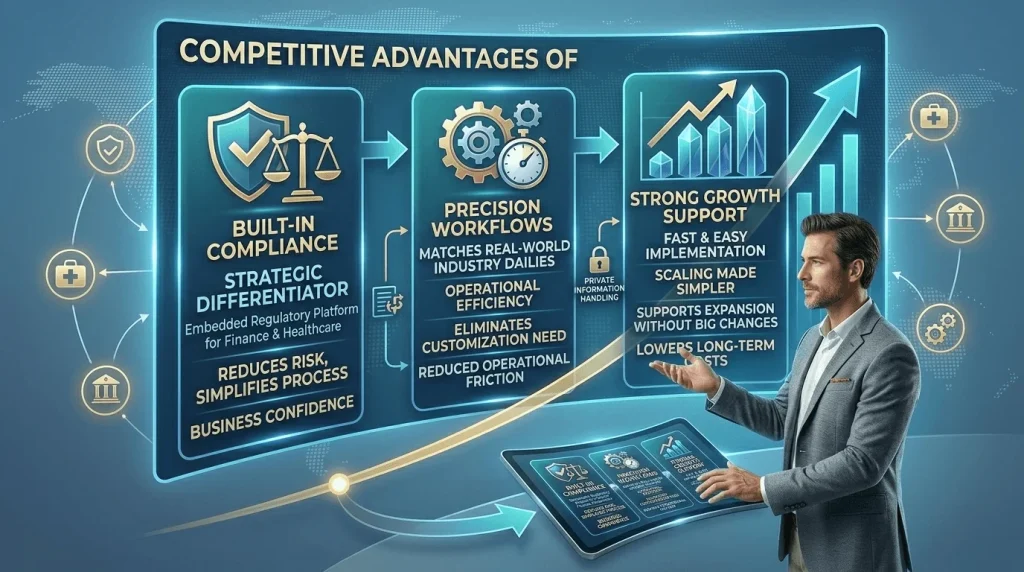
Investors and business owners are now preferring vertical SaaS, as they all want a tool that understands their problem and follows their rules. Every field has its own rules and its own customer needs. Vertical SaaS is built according to this pattern. There are many benefits of vertical SaaS for a business environment.
● Built-In Compliance as a Strategic Differentiator
Some fields, like finance and healthcare, have very strict rules to follow. By embedding a regulatory platform directly into the platform, a vertical SaaS provider reduces the risk and simplifies the compliance process. This gives businesses more confidence and helps regulated industries in following their guidelines.
● Precision Workflows and Operational Efficiency
Vertical SaaS is built to fit into the daily routine of industries and understand the customers’ needs. It is designed to match real-world workflows, eliminating the need for further customization. They can handle private information, leading to improved productivity and reduced operational friction.
● Strong Support For Growth
With company growth, the workflow becomes complex. Vertical SaaS is pre-configured for specific industries; implementation is fast and easy. It offers features that support your expansion without needing big changes or expensive customization. This makes scaling up simpler and helps keep your long-term costs lower.
Element Of Vertical SaaS
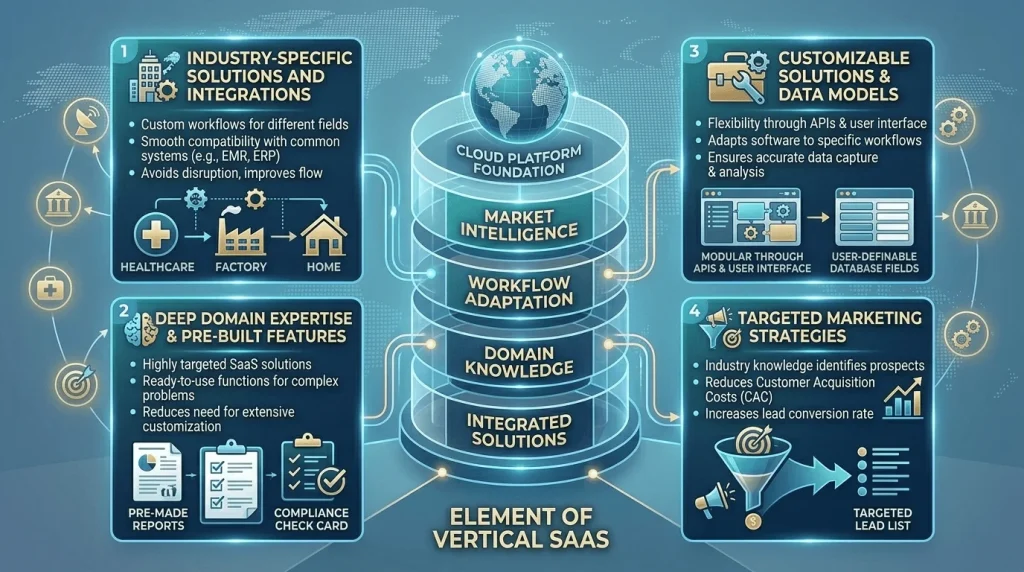
Vertical SaaS solutions are designed to cater to the unique needs of industries. Building on the foundation of the SaaS model, these solutions offer specialized functionalities and integration to address industry-specific challenges. It handles compliance requirements and operational tasks for sectors like healthcare, construction, or real estate.
1. Industry-Specific Solutions and Integrations
Custom software fits how different fields actually work, matching their own ways of handling information. Because it works smoothly alongside common systems like medical records in hospitals, it avoids disruption. Information moves without hassle between platforms. Efficiency improves since tasks flow better behind the scenes.
2. Deep Domain Expertise and Pre-Built Features
Vertical SaaS provider companies penetrate their industry’s knowledge, which enables them to develop a highly targeted SaaS solution to the problem. These SaaS have pre-built features that are made to fix the problem. It has a pre-built feature that addresses common industry challenges, reducing the need for extensive customization and improving user efficiency.
3. Customizable Solutions and Data Models
Although vertical SaaS is specialized for industrial problems, it also offers customization through APIs or user interference. This helps businesses to adapt the software according to their workflow and data models. This ensures accurate data capture, storage, and analysis.
4. Targeted Marketing Strategies
Vertical SaaS provider companies delve deep into industry knowledge. This helps them to reduce customer acquisition costs (CAC) and gain a pool of potential clients. It increases the lead conversion rate.
Strategic Implications for Enterprises, Founders, and Investors
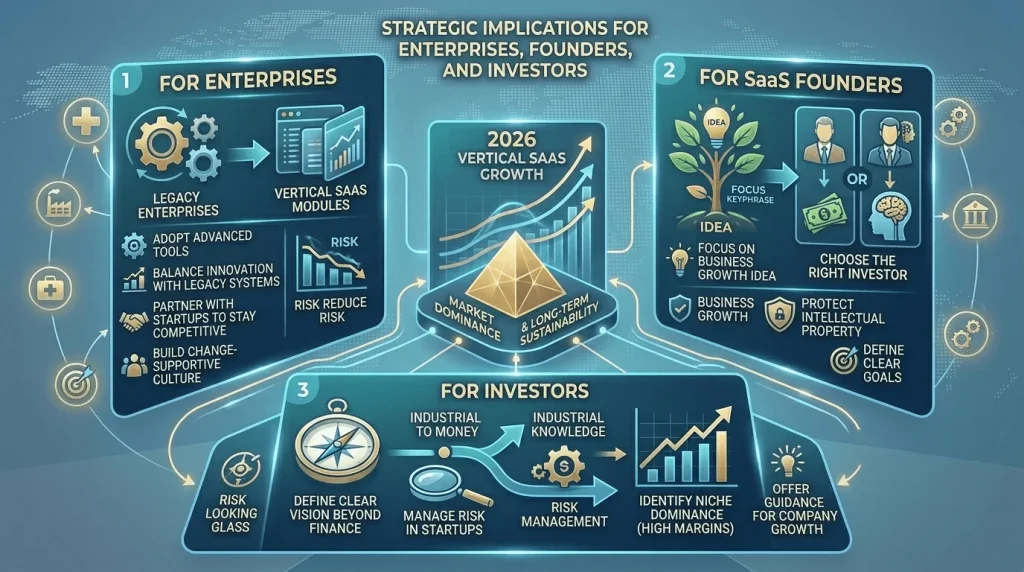
The rise of vertical SaaS in 2026 is real. Every investor, founder, or enterprise wants to invest in it. It has a lot of benefits for all investors and founders. But before investing in the enterprise, founders need to take a brief look at it.
● For Enterprises
Every enterprise needs to use an advanced tool with advanced technology. But before using any tool, they need to balance the innovation with their previous system. They should partner with a startup to get involved in a new environment and stay competitive. It also helps them to build a new culture that supports change and manages risk in a very appropriate way.
● For SaaS Founders
SaaS founders need to focus on building an idea that brings growth in business. Choosing the right investor is important. Some investors just gave money, while others gave industrial knowledge that helped to make SaaS even better. Founders need to be clear about their goal and also protect their idea to stay competitive in the market.
● For Investors
Before investing in any startup, an investor needs to be clear about their vision. They should look beyond the finance and competition. When working with a startup, managing risk is important. Companies that dominate niche markets achieve high margins and long-term sustainability by offering guidance to investors to help the company’s chances for growth.
The Future of SaaS: From Broad Platforms to Deep Ecosystems
The evolution of SaaS is complete, but the future of SaaS is moving away from the fragmented system. Now companies and industries need to use only those tools that are unified and solve their problem without any complications. Integrating AI and machine learning, these platforms enable predictive analytics and automation.
The future of vertical SaaS is marked by market growth, hyper-specialization, and the rise of micro-SaaS. Now, software is not just acting like a tool, but it is now working like a layer that operates a function. All this is just a result of artificial intelligence or machine learning. This evolution makes a fundamental shift from generalized to specified platforms, scalability, and smarter decision-making.
Vertical SaaS providers will ensure ongoing innovation and a competitive edge. By adopting vertical SaaS, businesses can build a robust digital ecosystem that supports sustainable growth and long-term success. With this business, it also stays agile and competitive in a dynamic market landscape.
The Hub for SaaS Innovation & Decision Intelligence
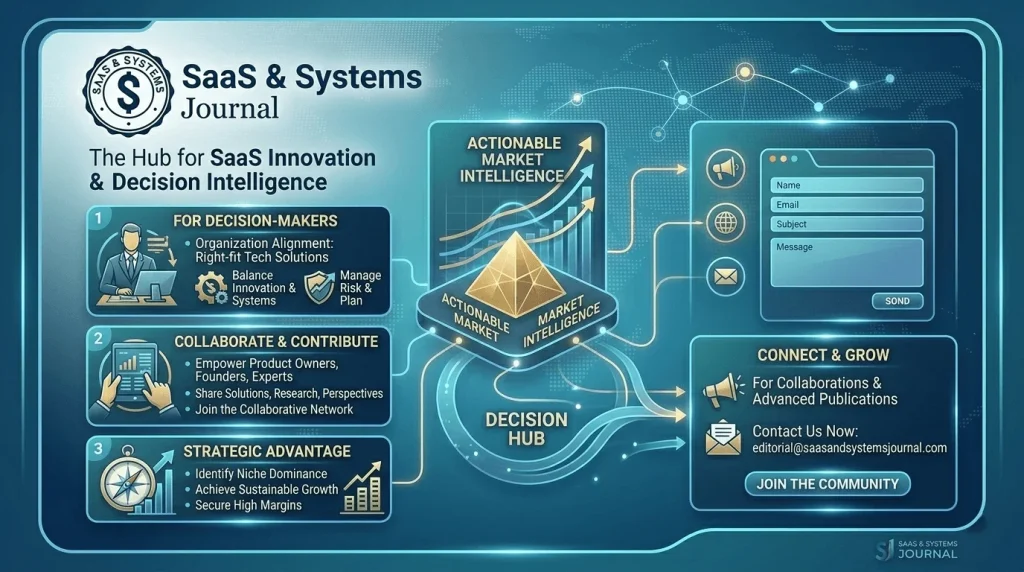
SaaS & Systems Journal is a leading digital platform for enterprise technology insights, B2B SaaS innovation, and cloud infrastructure research. We have designed it for decision-makers; it delivers actionable market intelligence to help organizations choose the right tech solutions.
Saas and Systems Journal empower product owners, founders, and industry experts to share their solutions, research, and perspectives. We create a hub for informed decision-making and future-ready innovation. Contact us now for collaborations and advanced publications.