
Summary:
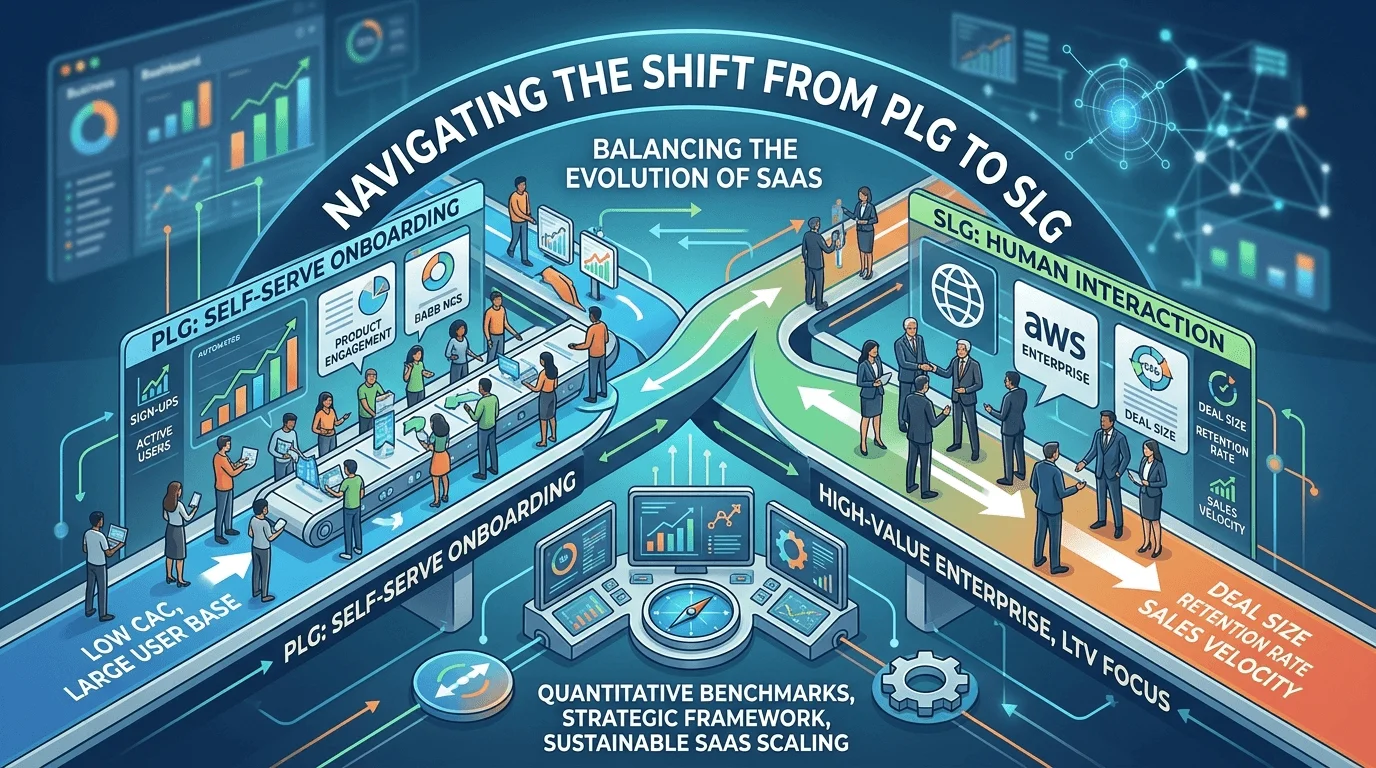
With the evolution of Software-as-a-Service, companies have to balance between product-led growth (PLG) and sales-led growth (SLG). This created a tension between PLG and SLG over which one is best. Due to self-serve onboarding, PLG offers low-cost customers and also helps to get a lot of customers. While SLG requires human interaction to dominate in a high-value enterprise. This paper will explore when a company needs to shift from PLG to SLG. This paper will use quantitative benchmarks, structured comparison, and a strategic framework to assist investors and business owners in shifting between PLG and SLG. metrics like Customer Acquisition Cost (CAC), Customer Lifetime Value (LTV), and sales funnel are analyzed to provide an actionable insight into sustainable SaaS scaling.
PLG vs. SLG: Balancing Product-Led Growth with Enterprise Sales Motion

Most software firms today do not stick to just one way of reaching customers. They shift between product-led and sales-led approaches, depending on how complex users are, the scale of deals, and income goals. What works often changes as needs change.
Free exploration kicks off when users dive in without barriers, through clear paths and learning by doing, yet SLG thrives on structured talks that close complex deals. As years pass, relying solely on PLG exposes weak spots, particularly inside big companies where approval chains, contract reviews, and team-based choices dominate the process.
Viral Loops
With product-led growth (PLG), expansion can snowball as users bring in more users. Yet hitting big companies usually slows that momentum, so leaning on sales teams becomes the next step.
What moment works best for SaaS firms to shift from product-led growth (PLG) to SaaS growth metrics to grab big deals while keeping things lean? When does that switch make sense?
Understanding PLG and SLG Models

Figuring out how PLG differs from SLG matters when shaping a SaaS growth plan that actually works. Because each model takes a separate path to bringing in customers, turning them into paying users, and then growing accounts. One leans hard on self-service tools so people can move without help.
Meanwhile, the other builds momentum through personal contact and trust over time. Looking closely at what they offer shows companies where to place bets depending on who they serve and how much they aim to earn.
Product-Led Growth (PLG)
What drives expansion? The product itself does. It pulls people in, keeps them hooked. Experience shows value, no need for old-school ads or pushy outreach. This is called Product Led Growth (PLG). Growth follows naturally from that first try onward. PLG enables scalability but often lacks the depth required for enterprise penetration.
Key Characteristics:
- Self-serve onboarding with minimal friction
- Freemium or free trial models
- Rapid time-to-value
- Data-driven iteration cycles
Customer Segmentation
PLG is most effective when targeting individuals, startups, and small-to-mid-sized teams that prefer autonomy over guided sales processes.
Typical Metrics:
- CAC: Low
- Sales cycle: Short
- Conversion model: Usage-driven
Sales-Led Growth (SLG)
People lead the way in SLG, guiding customers through buying, signing, and then growing relationships step by step. When deals get tricky or pricey, talking face to face makes all the difference – this approach thrives there. While SLG is resource-intensive, it unlocks significantly higher revenue potential.
Key Characteristics:
- Personalized demos and onboarding
- Dedicated account executives
- Long-term relationship management
- Negotiation-driven conversions
Enterprise Sales Cycle
When buying needs input from several people, the SLG approach works well. Long review phases slow things down, yet create space for deeper talks. Legal checks enter the picture, often paired with formal purchase rules. Conversations grow complex as departments weigh in one after another. Agreement must spread across teams before moving forward. Back-and-forth exchanges shape outcomes more than initial proposals. Decisions take time because many layers need to sync up.
Typical Metrics:
- CAC: High
- Sales cycle: Long
- Deal size: Large
Comparative Framework

Picture this: knowing what sets PLG apart from SLG shapes how a company grows. One moment you’re looking at who gets drawn in, the next you’re weighing expenses or how fast deals close. Deal sizes shift underfoot, some paths scale smoothly while others twist unpredictably. The way buyers move through decisions varies sharply between models. These contrasts quietly reveal which route fits a SaaS business aiming true. Each choice bends toward different audiences, different aims – clarity comes not from slogans but side-by-side observation.
Growth Model Comparison

| Factor | PLG | SLG |
| Acquisition | Self-serve | Sales-driven |
| CAC | Low | High |
| Conversion Speed | Fast | Slow |
| Deal Size | Small | Large |
| Scalability | High | Linear |
| Buyer Journey | Product-first | Sales-first |
Conversion Rate Optimization
Something happens beyond the surface. Product-led growth adjusts the inner mechanics of apps, smoothing early actions while shifting the spotlight among functions – each move quietly nudging users toward paying. A separate route unfolds through sales-driven methods: spoken exchanges build reliability, tailored answers tilt results, and closeness becomes key when deals are near completion.
The Economics behind the Shift
The decision to transition from PLG to SLG is rooted in economic trade-offs between cost efficiency and revenue maximization.
Revenue Expansion
PLG focuses on acquiring a large number of users at low cost, whereas SLG emphasizes extracting higher value from fewer customers.
Cost vs Value Equation

| Metric | PLG | SLG |
| CAC | Low | High |
| LTV | Moderate | High |
| Payback Period | Short | Short |
Unit Economics
Understanding unit economics is critical in determining whether the increased cost of sales is justified by the potential lifetime value of enterprise customers.
Retention and Expansion
Enterprise-led growth SLG strategies often achieve higher retention rates due to deeper integration and stronger customer relationships.
Churn Rate
PLG models may experience a higher churn rate due to low switching costs, while SLG customers are typically more committed due to contractual obligations and onboarding investments.
When Should SaaS Transition to SLG?
Figuring out when to move from product-led growth to sales-led momentum matters a lot if you want your software company to grow. Deal scale plays a role, so does how tricky customers are, what income targets look like, plus hints hidden in how people use the tool day by day. Getting the rhythm right boosts performance while unlocking bigger opportunities down the road.
The $100K Inflection Point
When deals get near $100K, doing it all on your own stops working. Bigger customers need more than just click-and-go setups; they bring tangled structures and deeper requirements. So moving from product-led to sales-led makes sense. Sales teams step in because complex organizations can’t win without personal contact. Closing big agreements takes conversation, not just automation.
Average Contract Value (ACV)
When ACV begins to exceed mid-market thresholds, the need for sales involvement increases significantly. At the $100K level, self-serve onboarding becomes insufficient to address enterprise concerns.
Key indicators include:
- Increasing deal sizes
- Complex feature requirements
- Security and compliance demands
- Multi-department adoption
Decision Matrix
| Condition | Recommended Model |
| Low ACV (<$10K) | PLG |
| Mid-market ($10K–$50K) | Hybrid |
| Enterprise ($50K+) | SLG |
Go-To-Market Strategy
A go-to-market strategy begins by linking function, cost, and place shaped around what people actually need. When these pieces connect, picking a path product-led, sales-led, or blended follows more naturally, guided by consistent sign-ups, retention, and revenue goals.
Behavioral Signals to Trigger Sales
- Increased product usage
- Team-level adoption
- Feature exploration depth
- Pricing page visits
Product Qualified Leads (PQLs)
Ready to engage one-on-one? Some users show clear signs they’re prepared for the next step. Heavy use of the product often points in that direction. Exploring features on their own tends to mean interest is growing. When entire teams start using it, momentum builds naturally. Personalized follow-up makes sense at this stage.
The Rise of Hybrid Models
The most effective SaaS companies today adopt hybrid models that combine PLG and SLG.
Upsell Strategy
PLG is used to acquire users, while SLG is deployed to expand accounts and close larger deals.
This dual approach ensures:
- Efficient top-of-funnel acquisition
- High-value bottom-of-funnel conversion
Funnel Optimization Strategy
Start by shaping how users move through your system – this ties PLG and SLG together without friction. Moving smoothly from first contact to active use happens when each stage pulls its weight. Some paths lead faster to signups, others build long-term value; both matter. What fits the product also supports outreach and follow-through
PLG Funnel
- Awareness through content and SEO
- Signup and onboarding
- Activation through product usage
- Expansion via feature adoption
SLG Funnel
- Lead generation and outreach
- Qualification and discovery
- Product demos and negotiations
- Closing and onboarding
Pipeline Management
Effective pipeline management ensures that leads are properly nurtured and converted at each stage. Because attention shifts happen, staying on top of contact moments matters more than speed. What stands out is how follow-ups connect across departments, often deciding who moves forward. When energy aligns between creators, promoters, and closers, results grow without pushing harder.
Funnel Comparison
| Stage | PLG | SLG |
| Entry | Free signup | Sales outreach |
| Qualification | Product usage | SDR filtering |
| Conversion | Self-serve | Sales negotiation |
Key Metrics That Drive the Decision
To effectively balance PLG and SLG, SaaS companies must monitor a set of critical performance indicators.
- Acquisition efficiency
- Conversion effectiveness
- Retention strength
- Expansion potential
Sales Efficiency Ratio
This metric evaluates how effectively revenue is generated relative to sales and marketing spend.
Metric Benchmarks
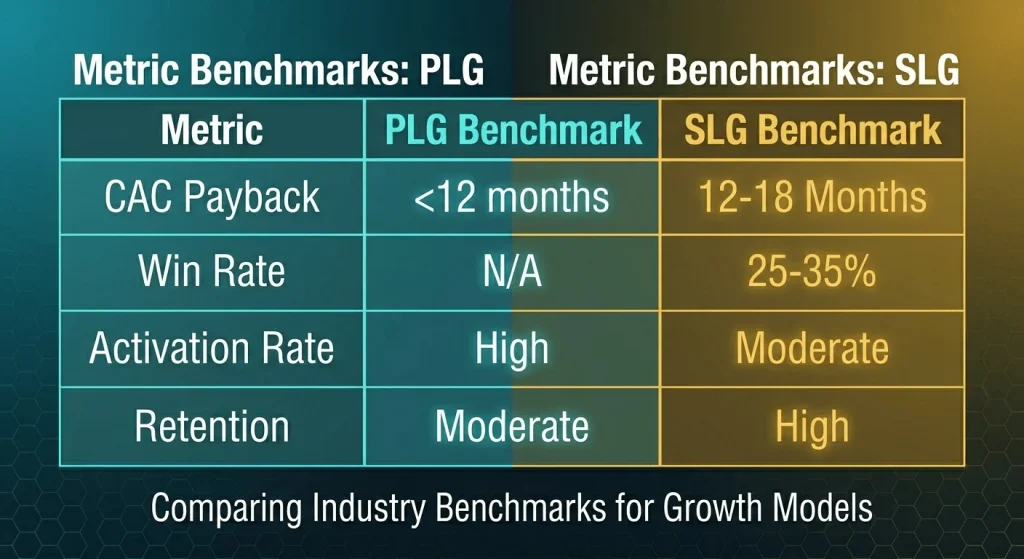
| Metric | PLG Benchmark | SLG Benchmark |
| CAC Payback | <12 months | 12-18 Months |
| Win Rate | N/A | 25-35% |
| Activation Rate | High | Moderate |
| Retention | Moderate | High |
Strategic Risks and Trade-offs
A single path doesn’t work for every SaaS journey PLG, SLG, or mixed methods each bring distinct hurdles. Though growth looks different across them, hidden costs might rise without clear customer targeting. Because expansion depends on how well limits are mapped early, foresight shapes outcomes more than speed ever does. Balance matters most when scaling quietly behind smart choices.
PLG Risks
- Limited enterprise reach
- Lower conversion at high price points
- Dependency on product experience
SLG Risks
- High operational costs
- Longer sales cycles
- Resource dependency
Hybrid Challenges
- Organizational misalignment
- Data fragmentation
- Attribution complexity
Customer Segmentation
Proper segmentation is essential to ensure that the right customers are targeted with the appropriate growth model.
Practical Implementation Roadmap

A clear path helps SaaS businesses grow when product, marketing, and sales work together on one plan. Shifting step by step from user-led to team-based selling lets firms expand smoothly – boosting sign-ups, cutting friction, holding value steady across phases, lifting conversions gradually without straining resources.
1: Pure PLG
- Focus on product-market fit
- Optimize onboarding experience
- Reduce acquisition costs
2: Assisted Sales
- Introduce sales teams for high-value users
- Identify expansion opportunities
- Build outbound strategies
3: Enterprise SLG
- Develop dedicated sales teams
- Focus on large accounts
- Optimize deal cycles
Revenue Operations (RevOps)
Ahead of every target sits alignment – marketing, sales, and support moving together. When performance gets measured, steps get repeated the same way, and groups work in sync, things move without snagging. Resources are where they’re needed most because someone is watching the whole path. Revenue operations aren’t left on the table when each phase feeds the next like clockwork.
Research and Publication Opportunities with SaaS and Journal

Now imagine sharing what you have seen work – actual tests, shifts like moving past product-led growth into sales teams, numbers on customer cost versus lifetime value. People who run software companies often look for these details when making choices. You can contribute to helping people at an industrial level by publishing your work on SaaS and Journal. Telling clear stories about those moments builds trust over time. It is less about titles, more about being known for honesty and clarity. When someone reads your experience, they gain insight without having to guess
Conclusion
Whether to lean on PLG or SLG isn’t really the point – what matters is when you use them, how they fit together, and how well you carry it out. Early traction? Mass reach? That’s where PLG shines, spreading fast without heavy lifting. Big contracts, tailored solutions, deeper relationships, that’s territory for SLG. Surprise twist: top SaaS players rarely pick sides. Instead, they blend both. Pull users in through product-led motion, then shift to sales-led moves to lock in revenue and push further. Success hides not in preference but in balance.