

As cyber threats evolve, implementing a robust Zero-Day Protocol for SaaS security has become essential for protecting distributed cloud environments. SaaS applications in modern-day power nearly every business function, right from the productivity suites to CRM and DevOps tools. The on-demand accessibility and the ease of deployment have led organizations to use SaaS apps, and 96 percent of the security leaders rank SaaS security as a high priority. Accessibility from anywhere, vast data sharing, and third-party integrations make SaaS attractive, but also make it challenging to secure it. Recent breaches, when observed, underscore that SaaS platforms are prime targets for attackers; over half of the organizations have experienced a SaaS security incident in the past 12–18 months.
There are certain high-profile attacks, such as Russian nation state actors Midnight Blizzard, which compromised a legacy OAuth app to access Microsoft 365 data, or the attackers started using stolen tokens from an Okta breach to infiltrate Cloudflare’s Atlassian SaaS instance. A SaaS attack surface means all the different ways someone could try to hack or get into an online software service.
These incidents highlight how the adversaries are directly targeting the SaaS to steal sensitive data. These incidents reveal that the attackers no longer need to breach the network perimeter if they can hijack the SaaS accounts or abuse SaaS APIs. Securing a SaaS requires the organization to take steps that go beyond traditional network-centric defenses.
Understanding the Zero-Day Threat in SaaS Environments
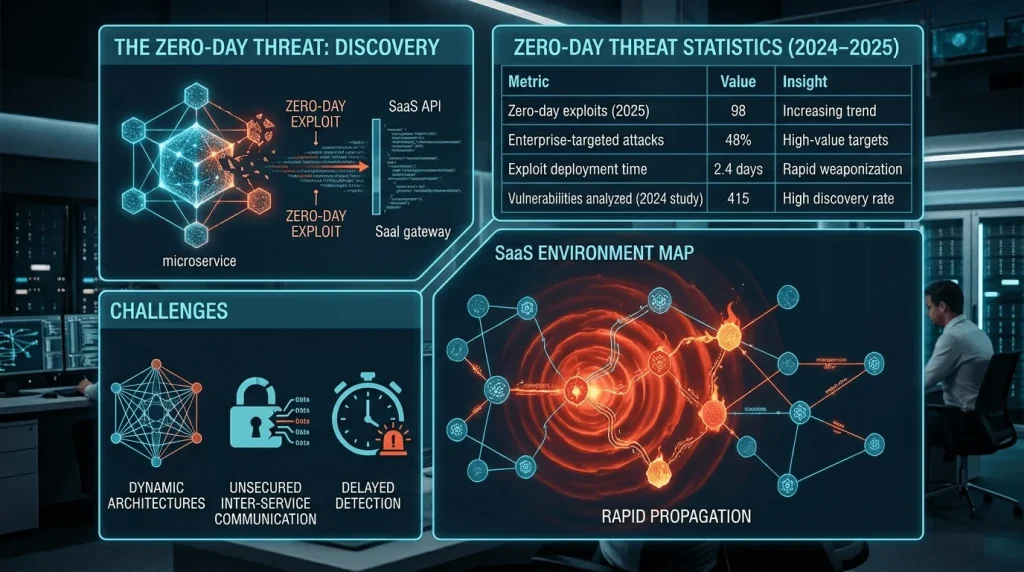
A zero-day vulnerability refers to a software flaw unknown to the vendor or security community, which attackers exploit before a patch is available. For distributed SaaS systems, zero-day attacks are particularly dangerous because they can propagate rapidly across micro services, APIs, and user endpoints.
Key challenges include:
- Dynamic architectures: Micro services and containerized applications increase attack surfaces.
- Inter-service communication: Unsecured channels can expose sensitive data.
- Delayed detection: Traditional reactive monitoring often identifies threats only after data exfiltration.
Research by MITRE ATT&CK (2022) indicates that 62% of breaches in cloud environments are linked to previously unknown vulnerabilities, highlighting the critical need for proactive measures.
Zero-Day Threat Statistics (2024–2025)
| Metric | Value | Insight |
| Zero-day exploits (2025) | 98 | Increasing trend |
| Enterprise-targeted attacks | 48% | High-value targets |
| Exploit deployment time | 2.4 days | Rapid weaponization |
| Vulnerabilities analyzed (2024 study) | 415 | High discovery rate |
From Reactive to Proactive Security: Introducing Chaos Engineering
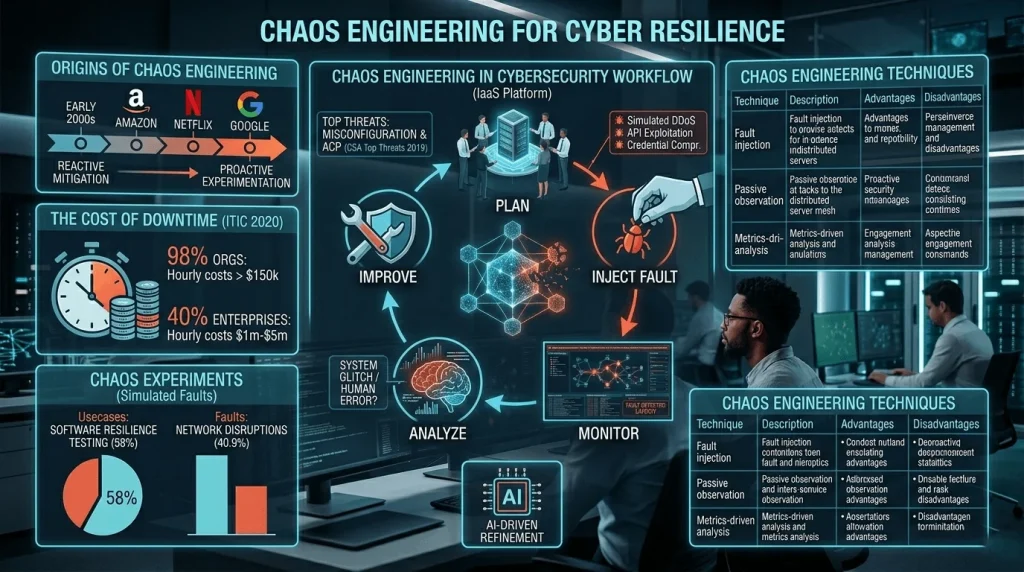
Chaos engineering (CE) is a pioneering discipline that focuses on proactively testing and improving the resilience of software systems by deliberately injecting controlled failures into them. Originating from the innovative practices of tech giants like Amazon, Netflix, and Google in the early 2000s, this approach challenges conventional wisdom by prioritizing proactive experimentation over reactive mitigation. This proactive methodology is particularly pivotal in the context of cloud computing, where dynamic, distributed environments are vulnerable to a range of unpredictable failures that can significantly impact service delivery and customer experience.
In cloud infrastructure (CI), issues are often caused by misconfigured resources. In the 2020 report by Information Technology Intelligence Consulting (ITIC), it was revealed that 98% of organizations report that an hour of downtime costs them over 150 thousand dollars. Furthermore, 40% of enterprises experience hourly downtime costs ranging from one million dollars to five million dollars. To address these issues, there is a pressing need for new security models.
Chaos Engineering in Cybersecurity
Cyber-attacks against Infrastructure as a Service (IaaS) cloud platforms have increased in recent years, mostly exploiting configuration vulnerabilities. These types of vulnerabilities include misconfigured Access Control Policies (ACP), over privileged users, and a lack of audit logging. Consequently, the Cloud Security Alliance (CSA) Top Cloud Computing Threats 2019 report identified data breaches due to misconfiguration and inadequate change control as the top 2, most severe cloud security threats. Similarly, the Ponemon Institute’s Data Breach Report 2019 disclosed that 49 % of breaches are caused by system glitches and human errors.
Chaos engineering techniques inject faults into software systems to detect availability issues, e.g., latency. Subsequently, these issues are resolved to improve system resilience, thereby enabling confidence in the system’s capability to withstand turbulence. According to research, 58% of chaos engineering use cases are in software resilience testing, and network disruptions account for 40.9% of simulated faults.
Security Chaos Experiments
Security Chaos experiments example include:
- Simulated DDoS attacks
- API exploitation
- Credential compromise
Chaos Engineering Workflow
Plan → Inject Fault → Monitor → Analyze → Improve
Chaos engineering techniques
CE employs various techniques to enhance system resilience. These include fault injection, passive observation, and metrics-driven analysis.
| Technique | Description | Advantages | Disadvantages |
| Fault injection | Introducing faults to test how systems endure under stress | Directly identifies system vulnerabilities | Can cause system disruption if not carefully managed |
| Passive observation | Before, during, and after the experiment, the behavior of the system is observed. | Real-world insights into system performance, reliability, and failure modes | May result in a delayed response to incidents or failures |
| Metrics-driven analysis | Assess system behavior, performance, and resilience. | Provides valuable data for root cause analysis and troubleshooting when incidents occur | The selection of metrics used for analysis may introduce bias or overlook critical aspects of system behavior or performance. |
The use of these techniques enables organizations to proactively address potential issues by continuously refining these methods, particularly with advancements in AI, and aims to enhance their effectiveness and applicability in increasingly complex IT environments.
Encryption and Secure Communication
Mutual TLS (mTLS)
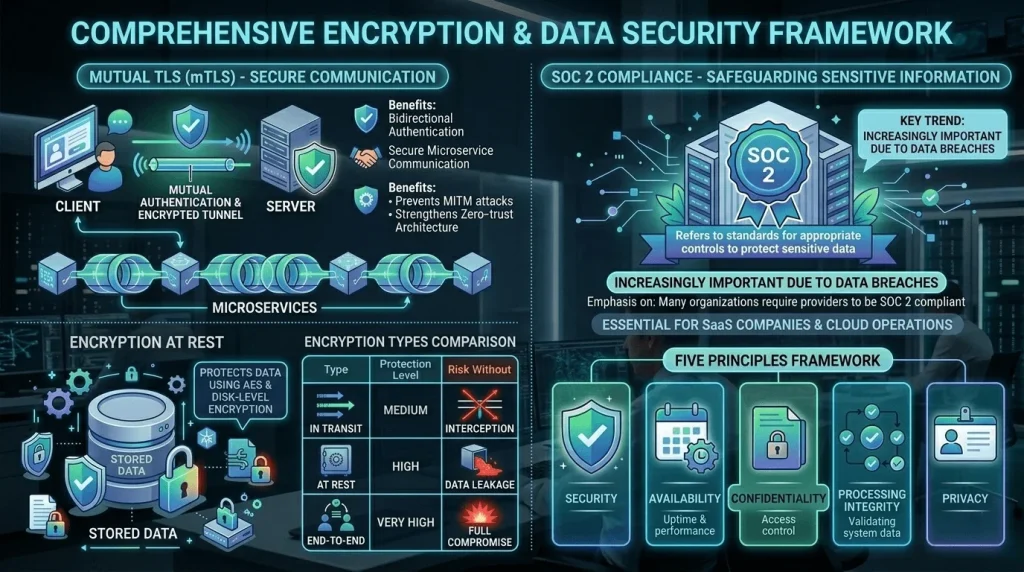
TLS is the most widely-deployed secure tunnel protocol, serving as the core of Internet communications. It establishes a secure channel between client and server via negotiating cryptographic parameters and authenticating the communicating parties. mTLS makes sure :
- Bidirectional authentication
- Secure micro service communication
- Benefits
- Prevents MITM attacks
- Strengthens zero-trust architecture
Encryption at Rest
Encryption at rest protects stored data using AES and disk-level encryption.
Comparison of Encryption Types
| Type | Protection Level | Risk Without |
| In Transit | Medium | Interception |
| At Rest | High | Data leakage |
| End-to-End | Very High | Full compromise |
SOC 2 Compliance
SOC 2 compliance has become increasingly important in recent years as data breaches have continued to rise. Many organizations now require their service providers to be SOC 2 compliant to protect their customers’ data. While achieving compliance can be challenging, it is essential for any company that handles sensitive information, especially for SaaS companies that operate in the cloud. SOC 2 compliance refers to the standards organizations must meet to ensure appropriate controls for protecting sensitive data. The framework includes five principles:
- Availability
- Confidentiality
- Processing integrity
- Privacy
Zero Trust Architecture
Traditional security models are increasingly inadequate in today’s rapidly evolving digital landscape. The concept of a secure network perimeter has dissolved as cloud computing, remote work, and interconnected systems become standard. Due to this new reality, Zero Trust Architecture (ZTA) has emerged as a compelling security framework. Recent industry analysis indicates a significant portion of organizations have experienced cyber-attacks that originated from compromised credentials rather than perimeter breaches, highlighting why security leaders are increasingly pursuing Zero-Trust implementations. Organizations with mature Zero-Trust frameworks generally report lower breach costs than those relying on traditional security models. The financial and operational benefits become apparent as security teams gain better visibility into their environments and can respond more effectively to potential threats before they cause significant damage.
The shift toward distributed work environments has created unprecedented security challenges, with remote endpoints multiplying rapidly since 2020. Security frameworks like those outlined in CISA’s Zero Trust Maturity Model suggest that organizations implementing comprehensive Zero Trust principles can substantially reduce breach impact severity and threat detection times compared to industry averages. This improvement stems from the fundamental approach of requiring explicit verification for every access attempt across network segments, effectively creating multiple security checkpoints that attackers must overcome to move laterally within environments.
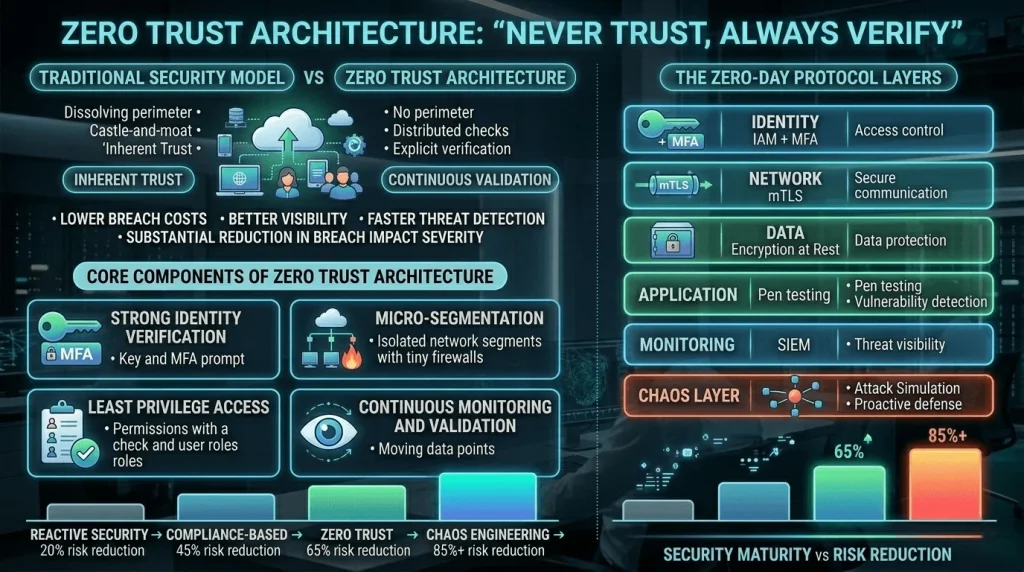
Understanding zero trust: “never trust, always verify.”
Zero Trust Architecture rejects the traditional security model where entities inside the network are inherently trusted. Instead, it operates on a simple yet powerful principle: no user, device, or application should be trusted by default, regardless of whether inside or outside the network perimeter.
Core Components of Zero Trust Architecture
- Strong Identity Verification
- Micro-segmentation
- Least Privilege Access
- Continuous Monitoring and Validation
The Zero-Day Protocol integrates multiple layers:
| Layer | Technology | Function |
| Identity | IAM + MFA | Access control |
| Network | mTLS | Secure communication |
| Data | Encryption at Rest | Data protection |
| Application | Pen testing | Vulnerability detection |
| Monitoring | SIEM | Threat visibility |
| Chaos Layer | Attack Simulation | Proactive defense |
Security Maturity vs Risk Reduction
Reactive Security → 20% risk reduction
Compliance-based → 45% risk reduction
Zero Trust → 65% risk reduction
Chaos engineering → 85%+ risk reduction
Role of Pen testing
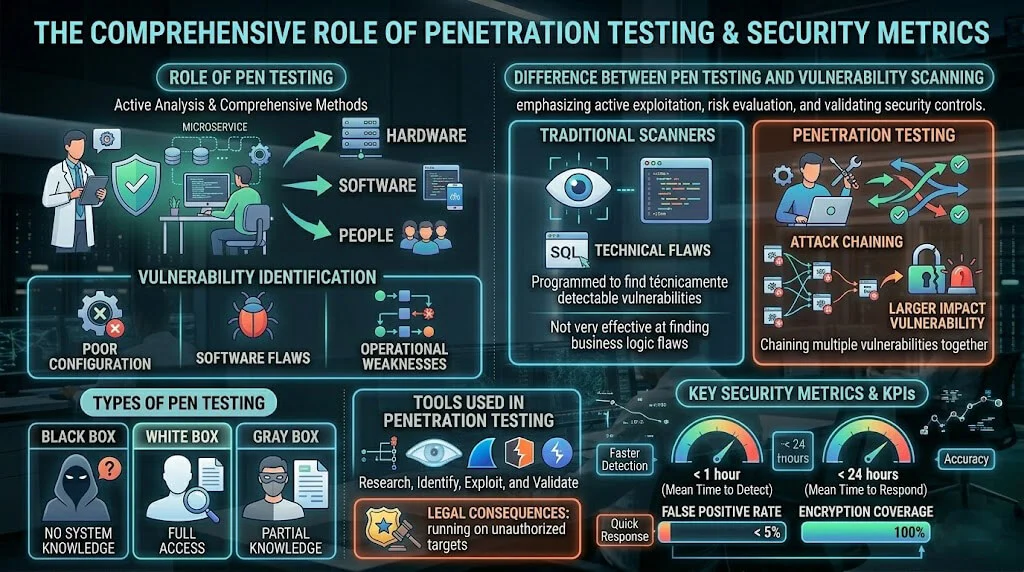
Penetration testing is a comprehensive method to test the complete, integrated, operational, and trusted computing base that consists of hardware, software, and people. The process involves an active analysis of the system for any potential vulnerabilities, including poor or improper system configuration, hardware and software flaws, and operational weaknesses in the process or technical countermeasures.
Types of Pen testing
| Type | Description |
| Black Box | No system knowledge |
| White Box | Full access |
| Gray Box | Partial knowledge |
The Difference between Penetration Testing and Traditional Vulnerability Scanning
Penetration testing differs from general vulnerability scanning by emphasizing active exploitation, risk evaluation, and validating security controls. For example, security scanners are not very effective in finding business logic flaws since they are programmed to find technically detectable vulnerabilities such as SQL injections or outdated libraries (Jones, 2025). Security scanners also perform poorly at chaining multiple vulnerabilities together into an attack chain that can lead to larger impact vulnerabilities than just the single vulnerabilities alone can.
Tools Used in Penetration Testing
Penetration testing relies on a variety of tools and research to identify, exploit, and validate vulnerabilities. It is important to note that many of the tools used for penetration testing are versatile and can be used in multiple categories and phases of the testing. (Cybergen Security, 2025.) Running penetration testing tools against unauthorized targets can lead to legal consequences.
Security Metrics and KPIs
Key Security Metrics
| Metric | Target | Importance |
| MTTD | < 1 hour | Faster detection |
| MTTR | < 24 hours | Quick response |
| False Positive Rate | < 5% | Accuracy |
| Encryption Coverage | 100% | Data protection |
Publish Your Work on SaaS & System Journal
SaaS & System Journal is an independent digital publication site where you can post your searches and papers. SaaS & System is especially dedicated to enterprise technology, B2B software architecture, and cloud infrastructure research. For questions, sharing your research, or working together, please visit the SaaS & System Journal.
Final Words
Zero Trust Architecture represents a set of technologies and a comprehensive security philosophy that fundamentally changes how organizations approach protection in interconnected environments. By assuming breach and verifying every access request regardless of source, Zero Trust provides a security model better aligned with the realities of modern enterprise computing, where traditional network boundaries have dissolved. While implementation requires significant investment, cultural change, and technical expertise, the resulting security posture delivers substantial advantages in threat detection, containment, and operational resilience.
The article creates multiple security layers that significantly complicate an attacker’s ability to move laterally within compromised environments, addressing one of the most common attack vectors in modern breaches. As organizations continue embracing remote work, cloud services, and digital transformation initiatives, Zero Trust transitions from an optional enhancement to an imperative foundation for security. The model’s focus on strong identity verification, micro-segmentation, least-privilege access, and continuous monitoring creates a blueprint for security that improves protection and delivers broader business benefits across visibility, compliance, operational efficiency, and organizational agility.
References
Shet, A., & Alsmadi, I. (2025). Empirical Analysis of Zero-Day Vulnerabilities
ZeroThreat AI (2025). Cyberattack Statistics Report
Springer (2025). Zero-Day Attack Best Practices
ResearchGate (2024). Zero-Day Exploits Case Study (Log4Shell)
MDPI (2024). Zero Trust Architecture Survey
Zhou, Q. (2019). ML for Zero-Day Detection
Owotogbe, J. (2025). Chaos Engineering Study
Reddit Cybersecurity Reports (2025)
https://www.epj-conferences.org/articles/epjconf/pdf/2025/06/epjconf_apitech-vii2025_02006.pdf